Friday, July 5, 2013

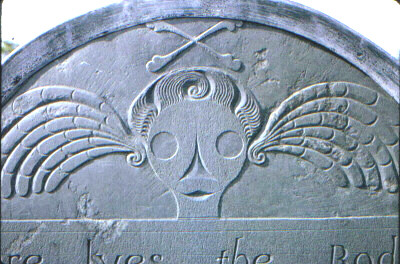
Headstone of James Wright, Carved by John Zuricher


John Zuricher was a gravestone carver of the mid-to-late eighteenth century. He lived with his wife, Elizabeth Ensler, and their ten children in New York City, but produced gravestones that can be found across the Hudson Valley, Long Island, and New Jersey, and even in Pennsylvania and South Carolina. As a stone mason, he worked on New York City Hall and made milestones for the Albany Post Road.

The stone in the photos above and below was created by Zuricher out of red sandstone for James Wright, who died in 1776. The decoration at the top is a round-faced cherub head with a crown of spiraling curls and quite distinctive wings, in which the feathers are laid out in a grid. There is also some sort of decorative flourish at the very top.

Anyone who has read James Deetz's masterpiece In Small Things Forgotten can tell you that there are three major phases of gravestone iconography in early New England and New York: death's head, cherub, and urn and willow. The cherub was a direct descendant of the death's head, and retained some of its features in a vestigial or reinterpreted state. For instance, that little nub of a chin at the bottom of the cherub's face evolved out of the jaw of the death's head - shown in this example. Furthermore, this stone represents the "missing link" between the death's head and the cherub.

It seems that Zuricher dealt exclusively in cherubs, which would make sense for the time period in which he worked (about 1749 to 1778). You can see more of his creations in this online gallery from Smith College.


Works Consulted:

Deetz, James. In Small Things Forgotten: An Archaeology of Early American Life. New York: Knopf Doubleday Publishing Group, 1996.

Ludwig, Allen I. Graven Images: New England Stonecarving and Its Symbols, 1650-1815. Middletown, CT: Wesleyan University Press, 1966. 

"Morbid Outlook: Identifying Gravestones in the NYC Area."

Veit, Richard Francis and Mark Nonestied. New Jersey Cemeteries and Tombstones: History in the Landscape. New Jersey: Rutgers University Press, 2008.

Clarence Perry


Clarence Perry, the three-year-old son of William and Alice J. Perry, died on May 5, 1885. I have had a hard time researching Clarence, for the following reasons:

-He was born and died in between census years, so I can't search his name.
-His parents have very common names, so I have difficulty searching for them, too. Plus, they don't appear in the two censuses that would be the most useful in identifying them: in 1880, they might not have been married yet, and the 1890 census is lost.
-He doesn't have any relatives in the cemetery ... or does he?

It occurred to me only after I put up this post that Clarence is grouped in the 1914 transcription with the Green family. Looking back at my posts on the Greens, I found that there was an Alice Green who was the daughter of John (1814-1896) and Mary Green (1816-1901) who are buried in the cemetery. Alice was born in 1847, which would make her about 35 when Clarence was born. Is she Clarence's mother?

I have not been able to confirm it. Maybe someone reading this can give me a lead!

Wednesday, July 3, 2013

UPDATE: The Haines Family

Haines family monument
The Haines family monument looks like it belongs in an Edward Gorey book. It's lovely and Victorian. The front panels are occupied by the names of Alexander, Martha, John D., Lyon M. Amy, and Sarah Haines. The back panels are blank.

Martha Dingee Haines lived quite a life. Born just a few years before the birth of the country, she lived long enough to see it torn apart by Civil War. She outlived her husband Alexander by forty years. 

Grave of Alexander Haines
The four other names on the Haines monument are that of Alexander and Martha's children: Amy, Sarah, John D., and Lyon Miller Haines. Lyon died in 1835 at the age of 27.

The 1850 census reveals an unusual situation in the Haines family. None of Martha's children seem to have married. Instead, they all lived together with their mother and a laborer named William Miller. John was a farmer.

1850 US Federal Census
Twenty years later, although their mother had died, the siblings were still living together in the same house (according to an article in the Westchester Historical Society Quarterly Bulletin, this was known as the "Widow Haines House" and was built in 1815). Interestingly, Amy is listed first as the head of household, perhaps because she is the oldest, or perhaps because the property was actually in her name. Her real estate was valued at $6500, while John had his own personal estate worth $625. They lived with a farmhand named Hiram Sarles and a thirteen-year-old girl, Ellen Cutler.

1870 US Federal Census
Amy Haines died in 1877, and John in 1879. Sarah was still living in 1880, age 79, and is listed in the census as "widowed." I would expect, however, that if Sarah had been married and widowed, she would use her husband's name instead of her maiden name. It's possible that she told the census taker that she was widowed, or the census taker assumed that she was. She died in 1892, still occupying the Widow Haines House.

As always, I'm left with questions, mostly about what this family was like. Why did none of the Haines children marry? Were they reclusive, nonconformist, or simply unusual? Did they stay at home to help their widowed mother? Were they close-knit siblings who would rather live with each other than with anyone else, or were they angry and bitter at having no choice but to share their mother's house?

Also - who put up the monument to the Haines family? Judging by its design, it wasn't there in Martha's time. One of the siblings must have arranged for it, or perhaps all three of them together. Perhaps Sarah Haines, having no children, nieces, or nephews, stipulated in her will that her money should be put to such a monument after she died. It was certainly an expensive monument, possibly the largest and most elaborate in the cemetery.

The knowledge of the Haines family's story certainly changes how I view the monument. The person who arranged for it to be made would have known that the Haineses would have no descendants, and because they were not famous, the monument would ensure that the family would be remembered in centuries to come.

The monument certainly got my attention, as did the Haineses' story. I have a fondness for what I call "genealogical orphans" - that is, people who have no descendants. You see, in genealogy everyone has a mother and a father at some point, but not everyone has descendants. Since most people are mainly interested in the history of their own direct ancestors, these "orphans" are in danger of being forgotten, especially if they - like most of us - weren't famous and had just ordinary lives. It's a shame, because these people aren't any less important or interesting because they didn't reproduce. For that reason I like to "adopt" them as my non-biological ancestors and research them. Haines family, you are officially on my list.

Oh, and my personal theory is that the Haineses were a close-knit family. To me their monument suggests pride not only in the family itself, but in its closeness. They lived together and now their names are immortalized together. But that's just my take on it.

NOTE: There will be a reward for anyone who could tell me where the Widow Haines House is and whether it is still standing. In 1942, it was occupied by Reverend and Mrs. Lee M. Fairchild and was said to be on the Straus Estate. I believe that it was near Jim Wood's house. I don't know what the reward will be, but there will be one.

UPDATE: Widow Haines house found.

UPDATE #2: Dick and Laurie were kind enough to give me a copy of the article "The Haines Family of Rye and Bedford" by Estelle Hobby Haines (published in The Westchester County Historical Bulletin). Estelle's husband was a descendant of Alexander Haines's brother Solomon, who is also buried in the cemetery, and Estelle actually knew Sarah Haines. Estelle writes:
Our family is indebted to Sarah Haines, the daughter of Alexander, for preserving the information about their ancestors ... Aunt Sarah, a straight old lady with white hair, gave the documents to my husband in 1885. On special occasions she wore a broadcloth cape reaching to the floor, a magnificent garment of long ago. She often spoke of her good neighbors, the Wood Family, whom she highly esteemed. To them she rendered inestimable service when their youngest son, James Wood 2nd, was taken seriously ill. Her nursing was considered the cause of his recovery and in appreciation Phebe Underhill Wood's copy of "The Imitation of Christ" was given her and in turn Sarah Haines presented it to the oldest of Phebe's sons. The volume bears these inscriptions reminiscent of three notable characters in that part of Bedford: Phebe Wood 1852 / Sarah Haines 1856 / Presented to Henry Wood by Sarah Haines 1880."

  1. Alexander Haines (1762-1821) m. Martha Dingee (1774-1861)
    1. Amy Haines (1798-1877)
    2. Sarah Haines (1800-1892)
    3. John D. Haines (1804-1879)
    4. Lyon Miller Haines (1808-1835)

UPDATE: Another Branch of the Haines Family


Here is something interesting: a line of four gravestones all with identical willow trees. You can see another willow tree on the right behind the stone of Peter Ferris. Obviously these stones were produced in the same workshop around the same time. How are the people to whom they belong related? Well, to begin with, the people are (according to the transcriptions):

Matthew Hains
Died December 11, 1830, age 37

Sarah, wife of Levi Foshay
Died March 5, 1841, age 45

Jerusha, wife of Nehemiah M. Hains
Died March 19, 1849, age 45

Solomon S., son of N[ehemiah] Merritt and Jerusha Hains
Died July 9, 1849, age 19

Peter N. Ferris
Died April 16, 1845, age 56

Since they all died before 1850 (the year when the census first listed all people, as opposed to just the householder), the relationships are a little harder to work out, but it's still possible to make some determinations. It was very useful that I discovered this transcription of the 1845 will of Solomon Hains. This is not the Solomon S. Hains who died in 1849, but rather his grandfather.

The will mentions Solomon's sons Godfrey, Nehemiah, and Joseph Hains, and his daughter Phebe Hains, who was unmarried. Solomon wrote that he hoped that Phebe's brothers would take care of her. He also mentions the four children of his son Matthew Hains, the implication being that Matthew was already dead (in fact, he is the owner of the left-most grave, and died in 1830).

Solomon Hains (1766-1845) and his wife Hannah (1766-1817) are in fact buried in the cemetery, although their stones aren't shown in the photo above. So is their daughter Phebe E. Hains (1796-1860). Although Nehemiah's wife Jerusha (1804-1849) and son Solomon are buried in the cemetery, he is not. Nor are his brothers Godfrey and Joseph Hains.

Solomon S. Hains died of consumption, according to the 1850 mortality schedules. At the time he was living in Seneca County, New York.

I have yet to work out how Sarah Foshay and Peter Ferris are related to the Hainses.

Godfrey Hains was a farmer, and he and his wife Ann had at least three children (Phebe, Matthew, and Abraham). The couple was still living in 1880.

Could Alexander Haines, the husband of Martha Dingee, have been the brother of Solomon Hains (1766-1845)? It seems possible: Alexander was born in 1762. His grave spells the surname "Hains" (as opposed to the family monument which spells it "Haines"). But Alexander isn't mentioned in Solomon Hains's will. Of course, it's still possible that this Solomon Hains isn't the father of the Solomon Hains (1766-1845) buried in the cemetery. Interestingly, on the 1851 map, Martha Dingee Haines and Godfrey Hains are neighbors.

UPDATE: Indeed, Alexander and Solomon Hains were brothers. They were the sons of Matthew Haines, a ropemaker, and Sarah Miller. I've updated the family tree below using information taken from "The Haines Family of Rye and Bedford" by Estelle Hobby Haines, published in The Westchester County Historical Bulletin. Estelle was married to Edward Haines, a descendant of Solomon Haines (1766-1845). Thanks to Dick and Laurie for getting the article for me. I have also added information from the article to the post on the Alexander Haines family.


  1. Matthew Haines (d. 1801) m. Sarah Miller
    1. Alexander Haines (1764-1821) m. Martha Dingee (1774-1861)
      1. Amy Haines (1798-1877)
      2. Sarah Haines (1800-1892)
      3. John D. Haines (1804-1879)
      4. Lyon Miller Haines (1808-1835)
    2. Solomon Haines (1766-1845) m. (1) Hannah Merritt (1766-1817); (2) Catherine (1783-1824)
      1. Matthew Haines (1793-1830) m. Elizabeth Sutton
        1. Hannah Haines 
        2. Mary E. Haines
        3. Samuel P. Haines
      2.  Phebe E. Haines (1796-1860)
      3. Godfrey Hains (1798-) m. Ann M. Powell (1796-)
        1. Phebe E. Haines (1829-)
        2. Matthew S. Haines (1831-)
        3. Abraham Haines (1839-1920)
      4.  Nehemiah Merritt Haines m. Jerusha (1804-1849) 
        1. Solomon S. Haines (1830-1849) 
      5. Peter Haines (1806-1842)
      6. Joseph Haines (1806-1888) m. Elizabeth Powell

Tuesday, July 2, 2013

The Old Church


This postcard that shows how the cemetery looked when the second church, built in the early 1850s, was still standing (the first church was built in the 1760s and was torn down in the 1810s). Can you recognize any of the stones? There are a lot of iron fences in the front of the church that aren't there anymore.

Here's another postcard, showing the back of the church:


And here is a third picture, using the same photo as the first, but in black and white.

The Three Wives of Mylon Sarles


Above is the gravestone of Ann Eliza Sarles. She was the first of three wives married to Mylon Sarles, a local butcher. Below, you can see her documented in the census at age 25, when she and Mylon had one child, three-year-old Ann. Adding to that Mylon's mother Anna Sarles, that makes three Ann(a)s in the Sarles family.

1850 US Federal Census
Ann Eliza Sarles died on July 6, 1853, at the age of 29, leaving two children: Ann and a son Mylon, who was born in 1852 or 1853. Mylon must have married his second wife, Caroline, before 1856, when their first child, Phebe, was born. They had two more children, Wilbur and Matilda, in the late 1850s. I'm not sure why Caroline isn't listed in the 1860 census with her husband and children, as she didn't die until 1870. Nancy Sarles is probably the same woman as Anna Sarles.

1860 US Federal Census
In 1870, the twice-widowed Mylon lived with his two children by Ann Eliza and his three children by Caroline, as well as 60-year-old Phebe Baker - Caroline's mother, perhaps?

1870 US Federal Census
As I mentioned before, Caroline Sarles died in 1870, and is buried in the cemetery.

(Source)
Ten years later, 57-year-old Mylon was living with a 25-year-old woman, Sarah, whom the census-taker called Mylon's wife. At first I thought that the census-taker must have confused one of Mylon's daughters for his wife, but Mylon didn't have a daughter named Sarah. If she was indeed Mylon's wife, she was younger than two of his children! Still, it's not out of the realm of possibility. Sarah had one daughter with Mylon, Ida, born nearly twenty years after his next youngest child.

1880 US Federal Census
Mylon died in 1892 at the age of 70 under quite dramatic circumstances. It seems from the obituary that I've transcribed here that Mylon died of a heart attack or stroke after chasing his drunken wife Sarah around the neighborhood. As he collapsed, he knocked over a lamp, starting a fire that caused his 15-year-old daughter Ida to yell for help. Their neighbors extinguished the fire, but Mylon was already dead.

Eight years later, Ida Sarles was living with her half-brother Wilbur, who ran a grocery store, in Manhattan. Though Wilbur Sarles is ten years younger than he should be given his age in earlier censuses, I believe he is the right person. The coincidence of a Wilbur Sarles living with a sister named Ida Sarles, who is the right age, is too much to ignore. It also makes sense that poor Ida would prefer to live with her brother rather than her unstable mother (or perhaps living with her mother was not a possibility, as Sarah was in jail. I haven't been able to find out whether she was ever charged in the death of her husband).

1900
  1. Mylon Sarles (1822-1892) m. (1) Ann Eliza (1824-1853); (2) Caroline (1829-1870); (3) Sarah (1855-)
    1. Ann A. Sarles (1847-)
    2. Mylon Sarles (1852-)
    3. Phebe Sarles (1856-)
    4. Wilbur Sarles (1857-) m. Mary (1871-) in 1890
      1. Mary Sarles (1891-)
      2. Alice Sarles (1893-)
    5. Matilda Sarles (1858-)
    6. Ida Sarles (1877-)

Obituary of Mylon Sarles (1892)

You can read the full post on Mylon Sarles and his wives here.

SUDDEN DEATH OF MYLON SARLES
We were quite surprised and shocked on Tuesday morning, to learn of the sudden death of Mr. Mylon Sarles, which took place the night before, under peculiar circumstances, at his house east of Lexington Avenue, on what is known as "Brooklyn," or "Poverty Flat."

The manner of his death and the events leading up to it, are about as follows - Mylon's third wife, still living, has for some time been addicted to drink, and on Monday night he went home at about 8:30 and found she was not there. He went down to Kate Fisher's house (formerly Nancy Francis's) and found her there, drunk. He took her up to his house, which is eastward across the lot, up slightly rising ground. Then he went outdoors to get some wood or something. While he was out, his wife slipped from the house, and went down to the Fisher house again. Mylon came indoors, and then started after his wife. He brought her back a second time, and probably exhausted by the job of the lugging her home, when he reached the house he was panting for breath and tired out.

What followed is not so clear, but in some way he fell or stumbled to the floor, and in falling struck the table in the room, on which a lighted lamp stood. The lamp fell over, the chimney broke, and the oil spilled out and ignited from the burner. It began to set the table on fire. The only other person in the house besides Mylon and his drunken wife was their 15-year-old daughter, who then ran to the door and screamed "Fire!"

The two Simonson boys, who live in a house near-by, ran to the rescue, and Willie the first one who reached the scene, put out the blazing oil lamp on the table, while the second Newton stumbled over the prostrate body of Mylon Sarles, and then picked him up off the floor. He was breathing very heavily, just like a person suffering from a stroke of apoplexy. He ran for a doctor, but had to go to both Dr. Augur's and Dr. Chapman's, to find one of them in, and by the time he returned, Mr. Sarles was just about dead.

Coroner Drews was notified early on Tuesday morning. He impanelled a jury, and from some statement that was made to him he committed Mrs. Sarles to the County Jail to be held until the inquest, which will take place to-morrow, Saturday. Mrs. Sarles was placed in the village lock-up on Tuesday morning, and was kept there until she was taken to White Plains.

On Wednesday evening, Dr. Augur, of this place, and a doctor from some town below here, made an autopsy on the body of Mylon Sarles, in order to discover the exact cause of death. The facts will be made known at the inquest.

The funeral services were held yesterday (Thursday) at his late residence, at two o'clock p.m., and the burial was in the old Episcopal Cemetery. Mr. Sarles was thrice married. By his first wife, he had two children, by his second wife, three; and by his last wife, one. It is only a few weeks ago that Mr. Sarles had his wife arrested for drunk and disorderly conduct. Mr. Sarles was about 70 years old, and a butcher by trade. Nothing particularly creditable can be said of his life and career.