Showing posts with label Sarles. Show all posts

Tuesday, August 18, 2015

Probates: Thomas Sarles


Thomas Sarles wrote his will on May 23, 1859, and died on October 9, 1860. I am willing to bet good money that this stone was not erected in 1860, or even 1870 or 1880. I don't think it was erected until after the death of Ann Sarles in 1887, when dark granite was fully in fashion, and it was becoming commonplace for couples to place their names adjacent to each other on one stone (rather than one above the other, in which case the man's name invariably came first).

Thomas Sarles is featured in the 1850 Non-Population Census, which records agricultural holdings. According to this record, Thomas owned 187 acres of improved land and 15 acres of unimproved land. His farm was estimated to be worth $11,500, with $250 in farming machinery. He owned three horses, thirteen milk cows, four working oxen, eight "other cattle," and fifteen swine. His livestock was valued at $1,034. Thomas Sarles's farm was the most valuable one on the census page. In the past year, he had produced:

150 bushels of rye
450 bushels of Indian corn
300 bushels of oats
100 pounds of wool
1,000 bushels of Irish potatoes
75 bushels of buckwheat
3,000 pounds of butter
80 tons of hay

As for the Population Census of that year, 54-year-old Thomas and 49-year-old Ann are recorded living with Samuel Sarles (29) and Aaron Sarles (12), plus a 14-year-old girl named Amelia Ford.

In his will, Thomas Sarles leaves his entire farm to Aaron, who appears to have been his youngest son. While the oldest son may have seemed like a more natural choice of an heir, it seems that Thomas's older sons George W. and Thomas E. had already left their parents' house and established their own farms prior to their father's death. Thus Thomas's will ensured that Aaron, who was only 22 at the time of his father's death, would also have a means of livelihood.

Although Thomas leaves his wife Ann $1000 and "the use of all my household furniture" (use, not ownership), she has no claim to his property. It may have been understood between Thomas and his son Aaron that Ann was to remain in the house for as long as she lived. Sure enough, in the census of 1870, Aaron - whose farm is now worth $18,000 - is living with his 70-year-old mother, who owns $3000 in personal estate. If Aaron had decided that he didn't want his mother to live with him, however, she would have had no legal protection. He would have had every right to throw her out of the house (with her furniture). This seems to have happened to several of the widows recorded living in the Westchester County Almshouse, except that they didn't even have $1000 to live on.

Thomas gives his sons George W. and Thomas E. more than twice the amount of money he gives to his daughter Phebe Hyatt, but as Phebe was already married, it's possible that Thomas had already given her money or property in the form of a dowry. In any case, as a married woman, Phebe would not have expected her father to provide for her, especially since her husband was Jackson Hyatt, a successful merchant who built the Mount Kisco Institute (which was later converted into the largest hotel in Mount Kisco). Still, the sum that Thomas did give his daughter - $2000 - was nothing to sneeze at.


  1. Thomas Sarles (1786-1860) m. Ann (1801-1887)
    1. Phebe J. Sarles (1824-1909) m. Jackson Hyatt (1819-1892)
    2. George W. Sarles (1826-1910)
    3. Thomas E. Sarles (1836-1869)
    4. Aaron W. Sarles (1838-1895)

Will of Thomas Sarles
I, Thomas Sarles, of the town of New Castle, county of Westchester and state of New York, do make, publish, and declare this my last will and testament in manner following, that is to say:

First, I do give and bequeath to my beloved wife Ann Sarles one thousand dollars and the use of all my household furniture during her natural life, and at the decease of my said wife I then give all my household furniture to my four children, namely George W., Thomas E., Aaron W. Sarles and Phebe J. Hyatt to be equally divided between them.

Second, I give and bequeath to my daughter Phebe J. Hyatt the sum of two thousand dollars.

Third, I give and bequeath to my two sons George W. Sarles and Thomas E. Sarles each the sum of four thousand and five hundred dollars.

Fourth, I give and bequeath to my son Aaron W. Sarles the farm on which I now reside with all the stock and all the farming implements, wagons, carriages, sleighs, sleds, hay, grain, on the ground or in the buildings on said premises.

Fifth and lastly, I give and bequeath all the rest, residue, and remainder of my personal estate or real not heretofore disposed of to my three sons namely George W., Thomas E., and Aaron W. Sarles to share and share alike.

Sixthly, I do nominate and appoint my sons George W. Sarles and Thomas E. Sarles my executors to this my last will and testament, hereby revoking all former wills by me made.

In witness whereof I have hereunto set my hand and seal this twenty-third day of May 1859.

Thomas Sarles

Witnesses: Moses W. Fish residing at Bedford in the county of Westchester; Philander G. Purdy residing at Bedford in the county of Westchester

Sunday, January 12, 2014

Finding Graves


Today I went to the cemetery to take some photographs for my new obsession, Find A Grave. While I have used Find A Grave for ages, I've only recently begun to add my own entries to it. At the lecture on Saturday, I met Barbara M., a member of the North Castle Historical Society who has worked with them to compile transcriptions from the town's historic cemeteries into a book. After seeing the result, I was inspired to work on the spreadsheet of transcriptions of the St. George's/St. Mark's Cemetery that I've been compiling over the past year. Find A Grave is the perfect way to keep track of all the photos I've taken for this project and access them easily.

In seeking out stones that haven't yet been photographed for Find A Grave, I found some that I'd never seen before (or at least remembered seeing). This stone is unusual - can you tell why?


As far as I know, no other stone lists only the mother on the gravestone of a child. If a stone lists one parent, it lists both. Was Elizabeth Clark a single mother?


Another mystery: Whose stone is this? I believe we found this fragment in the restoration last spring, but I have yet to match it with a name. "Joseph son of Hiram ..." is not listed in Eaderley's transcription of the 1910s, which suggests to me that the stone may have broken before then. Close by is the stone of Theodore G. Sarles, the son of Hiram and Ellen L. Sarles. Perhaps this is his brother.


Remember the Haines family? The stone of matriarch Martha Dingee Haines is nicely preserved as far as its legibility, but obviously needs a bit of work.


This is the only stone I have seen in the cemetery that has a Christogram. As you may recall, Mary and Luke Rooney were Irish immigrants. I have, however, seen it on gravestones in the nearby, contemporaneous Catholic Cemetery. Maybe someone can enlighten me - is the Christogram more of a Catholic than a Protestant symbol?


Tuesday, October 1, 2013

A Mystery Solved


Laurie found this amazing photo of St. Mark's Church at the historical society today. It shows a lot more detail, particularly the patterns in the windows, and will be very helpful in helping us to determine where the church was and how it appeared in the nineteenth century. It may help us understand some of the artifacts that we are unearthing in the old dry well, as well as the spatial relationship between the dry well and the church.

One of the first things I noticed about this photo was the presence of a certain gravestone that I had never seen before (actually, I had seen it in this photo, but I didn't notice it because it was so small in the image). This gravestone is not in the cemetery today.


In the photo below (taken winter 2012-2013), I have circled the place where this gravestone should be. The Philip and Nancy Sarles stone, with its distinctive Gothic peak, is visible in both the old and the new photographs - to the right of the church in the old photograph, and identified by the arrow in the new.


Now here is a close-up of the stone in question, with the contrast and definition of the image altered to make the inscription more legible. The dates are difficult to read, but the names appear to be Lyman W. Searles and Lydia A. Searles.

Once I had identified the names on the gravestone, I went directly to William Eaderley and Robert Miller's transcription of the cemetery, which was created in two stages - first in 1905 and second in 1909. Lydia and Lyman are not included, which suggests that their stone had probably already left the cemetery in May 1905. I say probably because Eaderley's 1905 transcription was not complete. The stone was certainly gone by 1909, when Miller created the complete transcription.

So where did the stone go? A search of Find A Grave revealed that Oakwood Cemetery contains two gravestones commemorating Lyman and Lydia Searles. Oakwood is mentioned in the foreword to Eaderley and Miller's transcription: "The [St. Mark's] cemetery is still used, and contains 425 stones; 1773 per 1906; only six bodies buried between 1905 and 1909, as most are now buried in the new Oakwood cemetery not far away."

As you can see in the old photo, Lyman did not have a death date under his name. Although Lydia's death date is not visible in the photo, the word "died" is visible, suggesting that the death date was there. So it's fair to guess that Lydia died first, and that the photo must postdate her death.

As it turns out, Lydia and Lyman's gravestones in Oakwood Cemetery are not the same as the stone in the photo; it is unclear what happened to the original stone. You can see the Oakwood stones, marked "Mother" and "Father," below.

(Source)

According to the inscriptions on these stones, Lyman, who was born January 23, 1826 (matching the date on the original stone) died in September 1905 (I can't make out the exact date). Lydia, who was born October 12, 1832 (again matching the original stone) died in November 24, 1893.

So what conclusions can we draw from all of this?

Well, to begin with, the photograph must have been taken after November 24, 1893 (Lydia's death), and was probably taken before May 1905 (Eaderley's transcription).

Lyman and Lydia's stone was likely removed from St. Mark's Cemetery before May 1905, and thus before Lyman's death. Therefore, Lyman was probably never buried in St. Mark's Cemetery, despite having had a stone with his name on it there. He was probably buried in Oakwood Cemetery, while his wife was buried in St. Mark's Cemetery and then moved to Oakwood before May 1905. Perhaps Lyman himself oversaw the relocation of his wife's body.

Lydia Searles was not the only person whose body was removed from St. Mark's Cemetery around this time and reburied in another location. The body of Charles Thorn, who was buried at St. Mark's in 1878, was moved to Kensico Cemetery by his wife in 1907.

Susan has noted that more than a few stones that are visible in old photographs of St. Mark's are absent today. This is the only such stone whose transcription is legible. It may be that some of the other missing stones and their accompanying bodies were moved as St. Mark's Cemetery began to decline and rural cemeteries became more popular.

Friday, September 13, 2013

Parthenia Sarles


Recently, I showed you the piece of ceramic that I found in the dirt surrounding a broken gravestone in the cemetery. Now, I thought I'd share a little bit about the owner of the gravestone, Parthenia Sarles. The mother of nine children - only five of whom I've identified - Parthenia was born around 1788 and died at the age of 70 in 1858, outliving her husband Stephen by ten years.

Stephen and Parthenia's three oldest children - J. Merritt, Hannah, and Caroline - are buried in the cemetery. Hannah and Caroline, who were born in 1813 and 1815 respectively, never left home, but continued to live in the family's house on Sarles Street until their deaths in the 1880s. According to Caroline's obituary, the sisters "spent many happy days" together.

The census below is from the year 1850, when the sisters and their widowed mother shared their home with their younger brother Albert and an eight-year-old boy named Edward.

1850
After Parthenia's death in 1858, Hannah and Caroline shared the house and were neighbors of Moses Fish and Smith Reynolds. Hannah died in 1881, and Caroline in 1888. This was Caroline's obituary:

MISS CAROLINE G. SARLES
Miss Caroline G. Sarles died at her home near New Castle Corners on Friday last, February 24.

She was the daughter of Stephen and Parthenia Sarles, and was born in Sarles street, in the town of Bedford, on Feb. 16, 1815, and had therefore reached the advanced age of seventy-three years and eight days. Miss Sarles was one of a family of nine children, five boys and four girls, of whom only two were older than herself. Of this large family but three are now living - Mr. J. Merritt Sarles, of Middle Patent; Jonathan H., of Brooklyn, and A. B. Sarles of Greenpoint. "Aunt Carrie," as she was familiarly called, had lived all her life in or very near the town of Bedford, and with her sister Hannah, spent many happy days in the house which was her home until she died.

By industry and frugality she accumulated considerable property, and won the respect and confidence of a large circle of friends, by her firm principles and goodness of heart.

When quite young she united with the Methodist Church, and ever after lived the life of a true and conscientious Christian. Through a long and painful illness she bore her sufferings with patience, and her greatest wish seemed to be to make the least possible trouble for her friends.

The funeral service was held on Tuesday last, from the New Castle M. E. Church, and her remains were interred in the old Episcopal Church yard.

The sisters' younger brother Albert died in Brooklyn in 1894. Their older brother J. Merritt outlived his sisters and brother, dying in 1897.

Thank you to Mike for the information on Albert Baker Sarles!

  1. Stephen Sarles (1790-1848) m. Parthenia (1788-1858)
    1. J. Merritt Sarles (1810-1897) 
    2. Hannah Sarles (1813-1881)
    3. Caroline G. Sarles (1815-1888)
    4. Jonathan H. Sarles
    5. Albert Baker Sarles (1831-1894)

Monday, September 9, 2013

A Find

While at the cemetery today, looking over the amazing work that the Eagle Scout team led by Chris has done on the Methodist part of the cemetery, I came across this little ceramic object sitting among the dirt and stones that have been excavated from the base of the Parthenia Sarles's broken gravestone. These photos show where it was located:


And these photos show how it looked after I cleaned it off at home. Presumably the excavation of the gravestone base was done by the team, and that this object was packed into the ground around the base along with the stones (which include several small pieces of other gravestones). Was the object part of the original fill used to erect Parthenia's stone in 1858? (This is assuming that Parthenia's stone was erected in the year of her death. Sometimes stones weren't put up for years after.)


And, of course, what is it? I'm guessing that it is the base of a candlestick. The photo below shows the underside, which is clearly worn where the base came in contact with another surface. You can also see the number "179." and a small X. I'm sure that a ceramics expert would be able to tell when and where this object was made.


Saturday, July 20, 2013

The Old Town

George W. Gorham's Store on West Main St. and Maple Ave.
I have recently been in touch with Frank, the grandson of town historian Oliver Knapp (and great-grandson of the Oliver Knapp pictured in this photo), who had been kind enough to share some of his photos of the old town, such as the store of George W. Gorham, above. Below is a photo of a man Frank thinks was probably a butcher, standing in the doorway of a building on West Main Street.

West Main Street, butcher?
At the time the picture was taken, the building below housed the local press, post office, and a pharmacy. In 1882 pharmacy was purchased by Stephen H. Sarles, who had started working there as a teenager.

1 January 1876

Sunday, July 7, 2013

A Sarles Family

(Source)
What is the relationship between these four Sarleses? By the way, did you know that there are five Thomas Sarleses buried in the cemetery? What, was the name Merritt not an option?

I'd like to take a moment here just to thank the volunteers at Find A Grave, which truly is one of the best free genealogy resources on the web. I like to have a photograph of the stone I'm researching, but if I've neglected to take one myself, I always go to Find A Grave to find one. They're fantastic! Not only are most of the graves in the cemetery covered already, but people continue to add stones to the database on a daily basis. You can tell how recently this photo was added by the posts and tape around Charles Haight's stone in the background, which have only been there since April. Find A Grave volunteers have been visiting the cemetery since our campaign began, adding photos not only of the stones, but of the signs we've put up next to them. They do great work.

Anyway, back to the Sarleses. Here are the names on the stone:

Leila May, died 1867
Mortimer S., died 1903
Harold, died 1904
Thomas H., died 1905

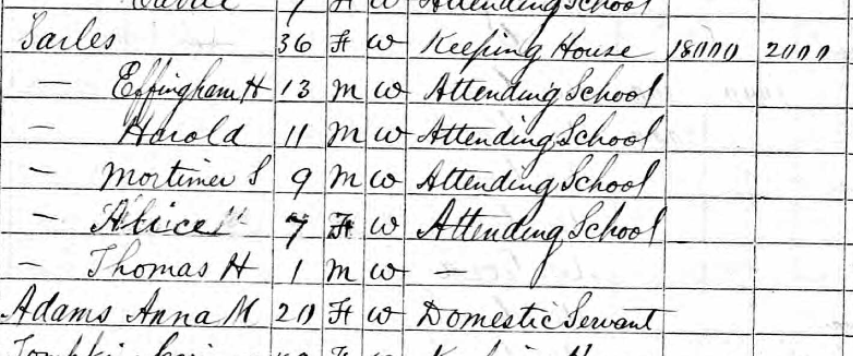
My first guess about these Sarleses was that they were a quartet of unmarried siblings, just like the Haines family. It turns out my suspicions were right on target. Here is the Sarles family in 1870. Note the presence of Harold, Mortimer, and Thomas (Leila would have died already). Also note that the census taker has neglected to fill in the name of the children's mother. I have called this census the Sexist Census before, due to the fact that the census-taker refused to list the first names of any married women, but instead listed them as "Mrs. [Husband's First and Last Name]." That is bad enough, especially considering that the 1850 and 1860 censuses do give the first names of married women, but look at this! Even when Mrs. Sarles is the householder, she doesn't get a name! And because her husband is dead, so she doesn't even get the courtesy of a "Mrs. [Blank] Sarles."

1870 US Federal Census
Thanks to the 1860 census, I know that Mrs. Sarles's husband's name was Thomas, probably the Thomas Sarles buried in the cemetery who died in 1869 at the age of 33, and that her name was Ernestine A. Hyatt.

Leila May Sarles isn't listed in the 1860 census. She was probably born between 1860 and 1867, and died as a child.

Harold Sarles didn't marry. In 1900, at the age of 40, he was living as a boarder in the house of his aunt, Catherine Hyatt, and her husband Oliver Van Cortlandt, and was listed as an "invalid." He died in 1904.

I might not have been able to identify Mortimer Sarles in the 1880 census, where he is listed as "M. S. Sarles," if it weren't for the fact that he was living in the same household as his brother would be 20 years later. While he lived with his aunt and uncle, 18-year-old Mortimer worked as a store clerk. 
He died December 16, 1903, in Jacksonville, Florida.

In 1910, Ernestine Sarles was living with her son Effingham, who was one of only two of her seven children still alive. At age 53, Effingham was listed as an "invalid," just like his brother ten years earlier. Did the Sarles children suffer from an inherited illness? Mother and son lived with three boarders at 339 West 50th Street.

1910 US Federal Census
During this time, Ernestine Sarles was embroiled in a court case regarding the estate of her "mentally incompetent" niece, Augusta Hyatt, which was estimated to be $400,000 (quite a sum back then). Ernestine died in 1911, leaving her brother Mortimer A. Hyatt and nephew George Hyatt Robinson as the last two relatives in the running. Ultimately George won.

Here's an article from the New York Times written when Augusta Hyatt was first declared insane.
New York Times 15 Dec. 1898
These articles, also from the times, announced George's victory over his uncle. Apparently George was a bit unstable himself, having been institutionalized by his wife in 1909 after an epic spending spree (seriously - he spent $500,000, the equivalent of 12.6 million dollars today, in 5 years).

New York Times 29 June 1912
New York Times 6 May 1914

  1. George E. Hyatt (1815-) m. Rachel (1821-)
    1. Augusta (1844-)
    2. Agnes (1847-)
    3. George (1849-)
  1. Thomas Sarles (1835-1869) m. Ernestine A. Hyatt (1834-1911)
    1. Effingham H. Sarles (1857-) m. Carrie G. Griswold (1860-)
    2. Harold Sarles (1859-1904)
    3. Mortimer S. Sarles (1861-1903)
    4. Alice Sarles (1863-)
    5. Thomas H. Sarles (1869-1905)
    6. Leila May Sarles (?-1867)
  1. Joseph Ryder Hyatt (1787-1848) m. Mary Pamela Montross (1796-1840)
    1. George E. Hyatt (1815-) m. Rachel (1821-)
      1. Augusta Hyatt (1844-)
      2. Agnes Hyatt (1847-) m. Charles Robinson
        1. George Hyatt Robinson
      3. George Hyatt (1849-)
    2. Jackson Hyatt (1819-1892) m. Phebe J. Sarles (1824-1909)
    3. Catherine Hyatt (1820-) m. Oliver Van Cortlandt 
    4. Oscar Warren Hyatt (1824-)
    5. Emily Hyatt (1826-1887)
    6. Mortimer A. Hyatt (1828-1916) m. Margaret L. Anderson (1827-1893)
    7. Minerva Hyatt (1830-1907)
    8. Ernestine A. Hyatt (1834-) m. Thomas Sarles (1835-1869)
    9. Pamela Hyatt (1838-1910)
    10. J. Effingham Hyatt (1840-1872)

Tuesday, July 2, 2013

The Three Wives of Mylon Sarles


Above is the gravestone of Ann Eliza Sarles. She was the first of three wives married to Mylon Sarles, a local butcher. Below, you can see her documented in the census at age 25, when she and Mylon had one child, three-year-old Ann. Adding to that Mylon's mother Anna Sarles, that makes three Ann(a)s in the Sarles family.

1850 US Federal Census
Ann Eliza Sarles died on July 6, 1853, at the age of 29, leaving two children: Ann and a son Mylon, who was born in 1852 or 1853. Mylon must have married his second wife, Caroline, before 1856, when their first child, Phebe, was born. They had two more children, Wilbur and Matilda, in the late 1850s. I'm not sure why Caroline isn't listed in the 1860 census with her husband and children, as she didn't die until 1870. Nancy Sarles is probably the same woman as Anna Sarles.

1860 US Federal Census
In 1870, the twice-widowed Mylon lived with his two children by Ann Eliza and his three children by Caroline, as well as 60-year-old Phebe Baker - Caroline's mother, perhaps?

1870 US Federal Census
As I mentioned before, Caroline Sarles died in 1870, and is buried in the cemetery.

(Source)
Ten years later, 57-year-old Mylon was living with a 25-year-old woman, Sarah, whom the census-taker called Mylon's wife. At first I thought that the census-taker must have confused one of Mylon's daughters for his wife, but Mylon didn't have a daughter named Sarah. If she was indeed Mylon's wife, she was younger than two of his children! Still, it's not out of the realm of possibility. Sarah had one daughter with Mylon, Ida, born nearly twenty years after his next youngest child.

1880 US Federal Census
Mylon died in 1892 at the age of 70 under quite dramatic circumstances. It seems from the obituary that I've transcribed here that Mylon died of a heart attack or stroke after chasing his drunken wife Sarah around the neighborhood. As he collapsed, he knocked over a lamp, starting a fire that caused his 15-year-old daughter Ida to yell for help. Their neighbors extinguished the fire, but Mylon was already dead.

Eight years later, Ida Sarles was living with her half-brother Wilbur, who ran a grocery store, in Manhattan. Though Wilbur Sarles is ten years younger than he should be given his age in earlier censuses, I believe he is the right person. The coincidence of a Wilbur Sarles living with a sister named Ida Sarles, who is the right age, is too much to ignore. It also makes sense that poor Ida would prefer to live with her brother rather than her unstable mother (or perhaps living with her mother was not a possibility, as Sarah was in jail. I haven't been able to find out whether she was ever charged in the death of her husband).

1900
  1. Mylon Sarles (1822-1892) m. (1) Ann Eliza (1824-1853); (2) Caroline (1829-1870); (3) Sarah (1855-)
    1. Ann A. Sarles (1847-)
    2. Mylon Sarles (1852-)
    3. Phebe Sarles (1856-)
    4. Wilbur Sarles (1857-) m. Mary (1871-) in 1890
      1. Mary Sarles (1891-)
      2. Alice Sarles (1893-)
    5. Matilda Sarles (1858-)
    6. Ida Sarles (1877-)

Obituary of Mylon Sarles (1892)

You can read the full post on Mylon Sarles and his wives here.

SUDDEN DEATH OF MYLON SARLES
We were quite surprised and shocked on Tuesday morning, to learn of the sudden death of Mr. Mylon Sarles, which took place the night before, under peculiar circumstances, at his house east of Lexington Avenue, on what is known as "Brooklyn," or "Poverty Flat."

The manner of his death and the events leading up to it, are about as follows - Mylon's third wife, still living, has for some time been addicted to drink, and on Monday night he went home at about 8:30 and found she was not there. He went down to Kate Fisher's house (formerly Nancy Francis's) and found her there, drunk. He took her up to his house, which is eastward across the lot, up slightly rising ground. Then he went outdoors to get some wood or something. While he was out, his wife slipped from the house, and went down to the Fisher house again. Mylon came indoors, and then started after his wife. He brought her back a second time, and probably exhausted by the job of the lugging her home, when he reached the house he was panting for breath and tired out.

What followed is not so clear, but in some way he fell or stumbled to the floor, and in falling struck the table in the room, on which a lighted lamp stood. The lamp fell over, the chimney broke, and the oil spilled out and ignited from the burner. It began to set the table on fire. The only other person in the house besides Mylon and his drunken wife was their 15-year-old daughter, who then ran to the door and screamed "Fire!"

The two Simonson boys, who live in a house near-by, ran to the rescue, and Willie the first one who reached the scene, put out the blazing oil lamp on the table, while the second Newton stumbled over the prostrate body of Mylon Sarles, and then picked him up off the floor. He was breathing very heavily, just like a person suffering from a stroke of apoplexy. He ran for a doctor, but had to go to both Dr. Augur's and Dr. Chapman's, to find one of them in, and by the time he returned, Mr. Sarles was just about dead.

Coroner Drews was notified early on Tuesday morning. He impanelled a jury, and from some statement that was made to him he committed Mrs. Sarles to the County Jail to be held until the inquest, which will take place to-morrow, Saturday. Mrs. Sarles was placed in the village lock-up on Tuesday morning, and was kept there until she was taken to White Plains.

On Wednesday evening, Dr. Augur, of this place, and a doctor from some town below here, made an autopsy on the body of Mylon Sarles, in order to discover the exact cause of death. The facts will be made known at the inquest.

The funeral services were held yesterday (Thursday) at his late residence, at two o'clock p.m., and the burial was in the old Episcopal Cemetery. Mr. Sarles was thrice married. By his first wife, he had two children, by his second wife, three; and by his last wife, one. It is only a few weeks ago that Mr. Sarles had his wife arrested for drunk and disorderly conduct. Mr. Sarles was about 70 years old, and a butcher by trade. Nothing particularly creditable can be said of his life and career.

Obituary of Nancy A. Sarles

I found this obituary of Nancy A. Sarles, who is buried in the cemetery, at the historical society today.
Mrs. Nancy A. Sarles, widow of Elkanah Sarles, died on Thursday morning, Jan. 12, 1899, at her home on the Steinhauser place, next to Mr. Dewitt H. Ransom's, southeast of the village, at the age of 85 years. The funeral will be held to-morrow (Saturday) at 11 a. m., from her late residence, Rev. A. T. Civill officiating. The interment will be in the old Episcopal Cemetery at New Castle.

Sunday, June 30, 2013

Philip and Nancy Sarles


Philip Sarles outlived his wife Nancy by nearly fifty years. She died in 1825, age 41; he died in 1872, age 88. When Nancy died, slavery was still legal in New York. Philip got to see the entire Civil War and a good chunk of Reconstruction. Not bad for someone who was born the year after the Revolutionary War ended.

Nancy is not the only Nancy Sarles buried in the cemetery. In fact, she is one of three. One lived from 1783-1863, and the other lived from 1812-1899.

There are no other Philip Sarleses buried in the cemetery, but I can imagine that he wasn't the only Philip Sarles running around town in the nineteenth century. Accordingly, it's somewhat difficult to say with certainty whether this Philip Sarles - who would have been born around 1787 - is the correct one. Shown here in the 1850 census, this Philip Sarles was a constable with an estate of $3,000, and was living with a family of Merritts. Figures. (None of these Merritts are buried in the cemetery, though.)

1850 US Federal Census
Unfortunately, this is the only census in which I can find Philip Sarles. He should be in the 1860 and 1870 censuses, but I can't find him. This is sad, since I'm sure that Philip and Nancy Sarles raised a whole flock of little Sarleses, as Sarleses are inclined to do. I would have liked to see if I could figure out who they were.

I did find an article in the Yonkers Statesman giving the "abstract of accounts audited by the Board of Town Auditors" in 1870, which named Philip Sarles as the constable (his account for the year was $6).

I also found a reference to the property owned by Philip Sarles: "a farm of about a hundred acres near Roaring Brook." After Sarles died, the property was owned by Abraham Hyatt.

Saturday, June 29, 2013

Hester Baker


Hester Baker's gravestone is located between that of her husband Benjamin and her granddaughter, "Little Emma." She was born Hester Sarles around 1811. In 1850, she and Benjamin, a farmer, had four children.

1850 US Federal Census
Ten years later, the Bakers had five children, including 25-year-old Phebe, who is inexplicably missing in the 1850 census. Had she been living with another family at the time? Catherine, who was one year old in the 1850 census, isn't present in the 1860 census. Did she die?

1860 US Federal Census
Hester died in 1864, and Benjamin in 1873. Their son Henry T. Baker married a woman named Susan and had three children in 1870.

1870 US Federal CEnsus
Benjamin and Hester's daughter Josephine married William Oliver Mosher, a farmer, in 1865. "Little Emma" is Josephine and William's daughter, who died in 1866 at one year old. A second child of the Moshers, Willie, also died at age one year in 1874 and is buried in the cemetery. Of William and Josephine's ten children, only two were alive in 1900, when the couple was living in Poughkeepsie, and 58-year-old William was working as a day laborer.

Josephine died in 1935 at the age of 89. This is her obituary in the Mount Vernon Daily Argus:

Mount Vernon Daily Argus, 19 March 1935

  1. Benjamin Horton Baker (1812-1873) m. Hester Sarles (1811-1864)
    1. Phebe H. Baker (1835-)
    2. Philo H. Baker (1841-)
    3. Henry T. Baker (1844-) m. Susan A. (1845-)
      1. Ella M. Baker (1865-)
      2. Emma S. Baker (1867-)
      3. Charles H. Baker (1869-)
    4. Josephine Sarles Baker (1848-1935) m. William Oliver Mosher (1842-before 1920) in 1865
      1. Julia Mosher (1864-)
      2. Emma Mosher (1865-1866)
      3. Edith Mosher (1868-)
      4. Willie H. Mosher (1873-1874)
      5. William A. Mosher (1879-) m. Jennie C. (1882-)
        1. Dorothy L. Mosher (1903-)
    5. Catherine A. Baker (1849-) 
    6. Seth A. Baker (1850-)
    7. Susan A. Baker (1851-)

Wednesday, June 26, 2013

A Quaker Cemetery


There is significant overlap in the surnames of the Episcopal Cemetery and the nearby, contemporary Quaker cemetery. To begin with, there are plenty of Sarleses in both. It's a reasonable guess that many of the Episcopalians and Quakers who shared surnames were actually relatives, perhaps even close relatives. Certainly, some of the people buried in the Episcopal Cemetery were Quakers, had been Quakers, or came from Quaker families, such as Charles Haight and Phebe Chase Greene.

Thorn seems to be a very common name in the Quaker cemetery, although I don't know whether there is any relation to Stephen Thorn (my guess: probably).


Coincidentally, Rose is also a very common name in the cemetery. Below you can see one of the very rare examples of decoration on the stones (the fact that I took so many pictures of the decorated stones makes the decoration seem less rare than it really is). The graves of Walton and Phebe Rose are engraved with their initials: WR and PUR. 


While the grave of Grace and Oscar Rose is marked with a Masonic symbol.


As you can see, the cemetery is quite overgrown, with some stones stranded in a sea of brush and debris. While this isn't good for the preservation of the stones, there's a certain beauty to the overgrowth. In some places, it's wild and lovely, with a fairy-tale sort of feel. It also serves as a physical manifestation of time.


Full disclosure: I came to this cemetery a lot when I was a child. You might say it was my first cemetery. So the landscape brings me back to that time when I was genuinely afraid of getting lost if I wandered too far out into what looked to me like a wilderness.


Still, the cemetery could probably use some work. Graves have been tossed around by this mutilated tree ...


... and many stones would benefit from a good cleaning.


Here you can see a child's grave that seems to match two child's graves in the Episcopal Cemetery: this one of John Howard and this one of George Henry and Lewis Seaman. It stands to reason that the Episcopalians and the Quakers would have bought gravestones from the same workshops.


On the other hand, the Quakers certainly did prefer their stones to be plainer, in general, than the Episcopalians did. During my brief time at the cemetery, I didn't see a single urn or willow, the hallmarks of mid-nineteenth-century gravestone decoration. I did see the rare ornamental flourish, such as the examples above and below:


I also didn't see any old sandstone graves with cherub faces, despite the fact that the Meeting dates back to the eighteenth century. I assume the reason is either 1) I missed them or 2) the Quakers weren't using gravestones at this time. Many eighteenth-century Quakers didn't use gravestones out of the belief that they were ostentatious. Others used extremely plain or blank stone markers. Some Quaker Meetings that had gravestones had them removed in the course of the eighteenth century.


These stones seemed to date from the mid-nineteenth century up to the present, with the best preserved stones being the granite markers of the late nineteenth and early twentieth centuries. Some stones were inscribed with the months in their Quaker form - that is, First Month instead of January.


Below are the stones that most fascinated me as a child. I thought they were doors that you could open into the underworld. It turns out I wasn't far off. I don't know what these stones are about - are they the lids of stone tombs that go down into the earth, or are they just markers placed on top of the earth? - but the basic visual and symbolic idea underlying the gravestone is that of a door. That is why some gravestones - mostly early ones like this - have architectural features like those you might find on a door (i.e., lunettes or tympanums).


While most of the gravestones are plain and undecorated, quite a few are massive. Take a look at this row of Sarleses, lined up right along the brim of the hill. They're quite impressive.


More Sarleses, of the same time period:


And here are some Underhills. That stone wall in the background could easily be as old as the cemetery itself.


Like the Episcopal cemetery, the Quaker cemetery has had some repairs done, but probably not recently. Broken stones have been fixed, and old stones have been placed on new bases.


Unlike the Episcopal cemetery, the Quaker cemetery is spread out. There are large open spaces in between the clusters of graves. In some places, the ground is level, and in other places it slopes dramatically. There are a lot of trees, a lot of weeds, and a lot to discover.


Lastly, here are the beautiful graves of the Quinbys and the Purdys, which are nestled into the roots of a tree. They're from the 1920s or '30s. The latest grave I saw today dated from 2009.