Showing posts with label Kirby. Show all posts

Monday, August 17, 2015

Probates: Richard Kirby

(Source)
When I first researched the Kirby family back in 2013, I mistook Richard Kirby's second wife, Rachel, for his daughter. It was an easy mistake to make, considering that in 1850 he was 69 and she was 45. Richard's first wife was Matilda Frost. The Kirbys were very prolific, and you can see their full family tree in the original post.

The wills I am reading are starting to fit into a pattern. The male writer of the will always instructs that his land be sold and that its proceeds be divided between his wife and children. Like the other men whose wills I have read, Richard Kirby's allowance to his wife is partly contingent upon her remaining a widow. However, unlike other men, who would cut off their wives completely in the event of their remarriage, Richard still allowed Rachel $100 a year. While cutting off their widows seems like a harsh thing to do, in reality it was simply a recognition of the fact that the widow's new husband would now be responsible for her maintenance. Redirecting her deceased husband's legacy to their children prevented it from falling into the hands of the widow's second family. These stipulations were intended to safeguard the woman's first family.

In 1851, when his will was written, Richard would have been 70 and Rachel 46. If she had remarried (which she doesn't seem to have), she would be unlikely to produce any more biological children. Perhaps this fact influenced Richard's decision; or maybe it was the fact that Rachel herself was his second wife. It is notable that Richard, like most of the other men whose wills I have read, doesn't simply give Rachel his property outright, but requires that it be sold, invested, and the interest to paid to her in installments. This practice would have seemed sensible back then, but today it comes across as somewhat patronizing, as though women couldn't be trusted to deal with their own property. Then again, perhaps women didn't receive the education in financial management that men did, in which case this practice would make sense - although the implication is no less offensive.

Notably, Richard only names sons in his will, not daughters. It could have been that he didn't have any daughters who lived to adulthood; I couldn't identify any. Then again, my search was complicated by the fact that when Richard and Rachel first appear in the census (in 1850), Richard's children with Matilda Frost had already grown. The sons he identifies as his youngest - William A., Charles H., and John Wesley Kirby - were most likely his sons with Rachel; they were living with the couple in that year and were aged 22, 20, and 18 respectively.

Also, that line "during her natural life." This is also meant to indicate that the property isn't really Rachel's; it's hers to use while she's alive, as though she's renting it. When she's done with it, it will belong to their children.

Leonard Kirby was the son of Richard and Matilda Kirby and married Jane Vervalen. He was a successful merchant who owned property both in New Castle and Manhattan, and had thirteen children. He died in 1878.

Valentine Kirby also became a wealthy merchant (he owned real estate valued at $120,000 in 1870) and lived in Queens with his wife Emeline, their children, and several servants. He died in 1894.

I haven't been able to find out anything about Caleb Kirby, who was doubtlessly named after the progenitor of the Kirbys, for whom Kirbyville was named.

Richard Kirby didn't die until 1857, six years after his will was written. Rachel died in 1863 at the age of 59.


Will of Richard Kirby

In the name of God, amen. I, Richard Kirby of the town of New Castle in the county of Westchester, this fourteenth day of June in the year of our Lord one thousand eight hundred and fifty one, being in good health and sound disposing mind and memory, thanks to almighty God for the same, and calling to mind the great uncertainty of this mortal life, do make and publish this my last will and testament in manner and form as follows, viz.

First: I order and direct my executors hereafter named to sell as soon after my decease as may be convenient and proper all my real estate and I hereby authorize them to give the purchaser or purchasers a good and sufficient title for the same.

Secondly: I order and direct my executors to take one equal half of the money arising from the sale of my farm and put the same out at interest on bond and mortgage and pay the interest to my beloved wife Rachel during her natural life provided she remain my widow, but in case she should marry, I order my executors to pay her the sum of one hundred dollars yearly in line (?) of the interest of said half of my real estate - and the money arising from my personal property after paying all my just debts and funeral expenses I give and bequeath to be equally divided between my beloved wife Rachel and my three youngest sons share and share alike.

Thirdly: I give and bequeath the other equal half of all the money arising from the sale of my real estate to my three youngest sons viz. William A., Charles H., and John Wesley Kirby to be equally divided between share and share alike.

Fourthly: I order and direct after the decease of my wife Rachel that my executors divide the money set apart as above stated for the use of my beloved wife and the interest of there should be any due and I direct that the same be equally divided between all my sons viz. Leonard, Valentine, Caleb, Isaac F., William A., Charles H. and John Wesley Kirby and their heirs share and share alike.

Lastly I hereby appoint my sons Leonard Kirby, William A. Kirby, and Charles H. Kirby executors to this my last will and testament and hereby revoking all former wills by me made do declare this to be my last will and testament in the presence of the witnesses named below, the day and year first above written.

Richard Kirby

Witnesses: Gilbert Brundage, W. H. Lane


  1. Richard Kirby m. (1) Matilda Frost, (2) Rachel (1804-1863)
    1. Leonard Kirby (1802-1878) m. Jane Vervalen (1813-1902)
    2. Valentine Kirby (1809-1894) m. Emeline
    3. Caleb Kirby
    4. Isaac F. Kirby
    5. William A. Kirby (1828-)
    6. Charles H. Kirby (1830-)
    7. John Wesley Kirby (1832-1901)

Thursday, April 10, 2014

Finding the Old Kirby/Hewlett Graveyard

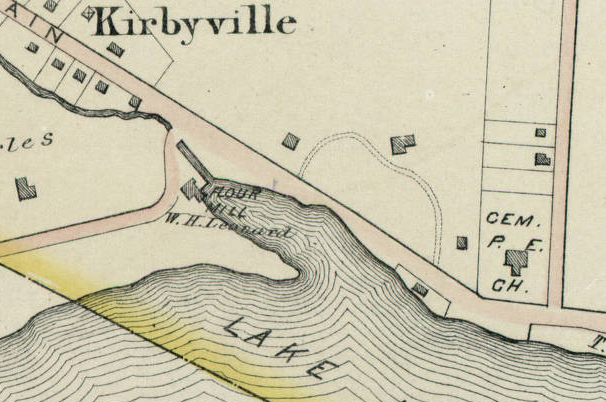
In the 1893 article about the di Cesnola graveyard controversy, the location of the graveyard is described thus: "Down at the southerly end of this pond there jutted out into it a little wooded peninsula which for over two hundred years has been used as a burying-ground."

This peninsula can be seen in the 1881 map of Kirbyville, not far from the old Kirby flour mill. Note St. Mark's Church in the right-hand corner of the map.

By 1901, the lake was gone, but the location of the graveyard can be approximated from the house General di Cesnola had built in its place.

Some version of this house seems to have been standing in 1929. Interestingly, the property line seems to echo the shape of the peninsula.


As for the satellite image of the area today - it is difficult to say, but it seems likely that the graveyard (if any of it remains) is in this general area.

The Graveyard that General di Cesnola Disturbed

The following article from the New York World, published September 8, 1893, was sent to me via Facebook by Mike Savoca, a descendant of one of the Spencer Optical factory workers. General Luigi Palma di Cesnola (1832-1904) was the first director of the Metropolitan Museum of Art. Born near Turin, Italy, he fought for the British in the Crimean War, then immigrated to the United States and served in the American Civil War. His estate in Mount Kisco, which abutted that of the notorious Judge Leonard, was sold to him by Albert and Mary Sarles in the 1880s.

General di Cesnola's reputation is somewhat tarnished by his haphazard methods as an amateur archaeologist and by allegations made by art dealer Gaston Feuardent that the general made deceptive restorations to the Cypriot artifacts in his collection (which formed the Cesnola Collection of the MMA). Feuardent's allegations, mentioned in the article below, were generally true. However, the focus of the article is another controversy: that surrounding di Cesnola's treatment of an old graveyard on his property that supposedly contained the remains of Patriot soldiers, in addition to members of the Kirby and Hewlett families. The "troubles" between the villagers and di Cesnola seem to echo those between the villagers and Judge Leonard. In each case, the villagers reacted with shock and disgust to the selfish abandon with which a wealthy man abused his power. On the other hand, both di Cesnola and Leonard felt they had the right to do with their property as they pleased. 

The question is now, does anything remain of the graveyard that di Cesnola destroyed? I am currently on the case. Thanks to Mike for sharing this with us.

Patriots' Bones Dug Up.

Mount Kisco People Say Harsh Things About Gen. di Cesnola's Act.

AN OLD BURYING-GROUND EXCAVATED FOR A DWELLING.

Commissioner Daly Ordered Cesnola's Overseer's House Removed, and the General Moved It Into Burying Ground - Gen. Cesnola Says Only Two Bones Were Dug Up - He Says It's His Burying-Ground, Anyway.

Gen. di Cesnola, of Cyprus and the Metropolitan Museum of Art, has been rummaging among dead men's graves again. It has been known for years that the General was the owner of a private graveyard. Not that he made it himself, the way they do in Texas, but he bought it outright.

It was in 1882 that Gen. di Cesnola bought the graveyard. He bought it as part of a tract of seventy-five acres of land about a mile and a half east of Mount Kisco. He bought it of Albert Sarles, and Sarles had bought it of Hulett. Hulett had bought it of the Kirbys, who owned over a thousand acres of land in and around New Castle Corners, an outlying flank of the village of Mount Kisco.

The tract of land which Gen. di Cesnola bought bordered the eastern and northwestern side of a long, irregular little sheet of water known for generations back as Kirby's Pond. Judge Leonard bought the pond two years ago, blew up the dam which made it a pond, drained it, and made some very soggy meadow land on which bullfrogs and bullrushes thrive.

Down at the southerly end of this pond there jutted out into it a little wooded peninsula which for over two hundred years has been used as a burying-ground. It began as a private burying ground for the Kirbys. Then when the Huletts came into possession they buried their dead in it. It was thrown open by courtesy to other families in the neighborhood, so that for a while, strictly speaking, private property, it came to be in reality a public place for interring the dead. Many soldiers of the Revolution killed in the fighting above White Plains were buried there.

The General had hardly time to acquaint himself with all the features of the land he ha bought before a committee of three waited upon him. They were substantial American citizens and sound Presbyterians and came to see the General about a rumor. The rumor was that the General, being a Catholic, was bound to do just what the Catholic priest had told him to do and the report was that the priest had told him to rip up that Protestant burying-ground and scatter the bones and dust of the dead to the four winds of heaven.

The General relieved their minds. He told them that he was not going to disturb the burying-ground. He told them furthermore that when he submitted to the dictation of any Catholic priest, Cardinal or Pope, as to what he should do with his own private property, he would be a very much older and very much c hanged man from what he then was.

That was trouble number one.

Then a man named Feuardent broke loose. Feuardent was a sceptic and a scoffer about the Cyprian treasures which the General sold to the Metropolitan Museum of Art for such a tidy sum of money. Feuardent said that Di Cesnola was a fraud. Di Cesnola replied.

In the heat of the debate Feuardent accused di Cesnola of having just bought another graveyard in Westchester County for the purpose of ransacking it for skulls and coffin plates to sell to art museum gulls.

That was trouble No. 2 about the graveyard, and now we come to the third and last of the General's burying-ground woes.

That began about six weeks ago, and it originated in the office of Michael T. Daly, Commissioner of Public Works. Commissioner Daly, in his efforts to keep the source of the Croton water supply from contamination, promulgated an edict that the house in which William Garrison lived had to be moved. Garrison had been overseer of Gen. di Cesnola's farm for over ten years. He said if the house was moved he would have to throw up his job and move, too, for he could get no place near by to live in.

Gen. di Cesnola was perplexed, but he had an inspiration. Why not put Garrison in the graveyard? As he thought of it it grew in his estimation to the proportions of a great scheme. He carried it out. He hired Pete Archer to move the house Garrison had lived in bodily over to the graveyard, and before he did that he hired William Wetherell to scoop away enough grave-tops and dig down into enough grave-bottoms for the house to rest on and have a cellar under it.

It was this despoiling of the last resting place of the dead, and particularly of the patriot dead of the Revolution, which has brought down upon the General the final and most serious of all the verbal attacks which his purchase of the graveyard has developed. It is discussed with much bitterness by people for miles around Mt. Kisco and Newcastle Corners.

The General had not been popular with the country people to begin with, and this last act has made them like him less than ever. Extravagant stories as to the number of the bones dug up and the sacrilegious way in which they were handled are going about. As a matter of fact but few bones were dug up. Just how many is a matter of dispute. William Archer says he only saw two and that they were leg bones. This is what Gen. di Cesnola says:

"The house is not in the graveyard proper, but in the front of it. I was present during all the excavations and present for the very purpose of seeing if any bones and relics were turned up. I am too much interested in antiquities to let an opportunity like that pass. If any bones were dug up I intended to put them in a coffin and have them decently interred. Two bones were dug up. They were leg bones, but whether of a man or a woman I could not tell. I told my overseer to put them aside and take care of them. He did put them aside, but the next morning they were gone, and since then we have not been able to find any trace of them. That is all there is to the story.

"The place was never a public cemetery, and if people choose to sell the land in which the bones of their forefathers rest they must not complain if strangers show as little respect for the place as they have shown. The proprietorship of that land lay between me and Judge Leonard. Judge Leonard said if I did not claim it he would. My deed fully shows that it was included in my purchase, and in a suit I had with a telegraph company that was putting up lines Judge Dykman, at White Plains, held that it was mine. Nobody has said anything to me about what I have done, but I suppose they talk among themselves."

Gen. di Cesnola scraped away the soil for the foundation and a little back yard to the house for a depth of about three feet. About [illegible] feet distant from the line of excavation there are two tombstones in good condition, one of white marble and the other of brownstone. Both are moss grown, but the inscriptions are very plain. One reads:

In 
Memory of
Rosannah
Hewlett
who died
July 2, 1836
Aged 67 years
3 months and
Four days

The other, which is the one of brownstone, erected to a member of one of the Kirby family, and this is all that bear legible inscriptions, although there are the outlines of scores of graves visible, many of which have only the broken stubs of headstones sticking out of the ground and are evidently very ancient.

Monday, February 24, 2014

Kirby Pond and Leonard Park

 "After many years of litigation the old Kirby Pond, which covered 160 acres of land, was yesterday drained and has become one of the things of the past. It was owned by old Judge Leonard, who is now stricken down with apoplexy and he has had a hard fight in the courts to drain it. He was opposed by the people generally, who feared that the draining would prove deleterious to the public health of the village, and by the Spencer Optical Works, which were situated on its banks and in whose business it was an important factor. Not long ago, however, they had a good offer made them and removed to Newark, N.J., and taking a large number of operatives with them and throwing many more who could not go out of employment. The people of the village were present in full force yesterday to see the pond drained and, armed with pitchforks, succeeded in catching or spearing a great quantity of fish. A large number of dead fish were left on the muddy bottom, and it is feared that they will create an unpleasant effluvium and possibly cause sickness unless the weather continues cold. Taking it as a whole, the community regard the draining of the pond as a detriment and a calamity to the village."
-The New York Times, 7 December 1888


 "Leonard Park is a center of outdoor fun today thanks to two generous families who donated part of their good fortune to the village more than a decade ago. In 1943 Col. William Leonard decided to grant some 95 acres of his land to the village to be used for park and recreational purposes ... In 1949 the Memorial Pool was constructed on the property in memory of the local men who gave their lives in World War II ... "
-Yonkers Herald Statesman 29 August 1962


Monday, April 29, 2013

30: Richard and Rachel Kirby

(Source)
"Rachiel" Kirby - unconventional spelling or engraver's mistake? For now I'm going to assume it's the latter. I don't think I've ever seen Rachel spelled that way.

At first I mistook Richard and Rachel Kirby for husband and wife. In fact, she's his daughter. (Correction, August 17, 2015: She was his wife! See here.) Rachel's mother was Matilda Frost, who is not buried in the cemetery. Richard, a farmer, was born around 1781 and died in 1857.

Rachel was born in New Jersey in 1804. In 1850, she lived with her father and three Kirbys whom I am assuming are her brothers. There was also a 17-year-old girl, Cecilia Smith; I'm not sure how she fits into the picture.
 
1850 US Federal Census
Joseph Kirby (1801-1849)
Rachel's older brother Joseph, who was born in 1801, married Mary Ferris and became a miller. On August 12, 1849, he died suddenly of unknown causes, according to the 1850 United States Federal Census Mortality Schedules. After her husband's death, Mary was living with a man named Philip Clapp, a woman named Adelia Horton, and Adelia's daughter Emily.

1850 US Federal Census
Although she died in 1879, I can't find Mary in the 1860 or 1870 census.

Leonard Kirby (1802-1878)
Rachel's older brother Leonard Kirby was born around 1802. He married Jane Vervalen, who was born in New Jersey in 1813. They had thirteen children, only five of whom outlived their mother.

In 1860, Leonard and Jane lived near the cemetery with their nine children, three servants, and two laborers. Leonard was a merchant.

1860 US Federal Census
Leonard died in 1878, after which Jane lived with relatives in New Jersey and then in Westchester. In 1900, she was living with her daughter Louisa and her husband Alexander H. Mood, a traveling salesman, as well as the Moods' son George, Jane's daughter Adelaide, and one boarder.


When Jane died in 1902 at the age of 89, it was a full hundred years after her husband Leonard's birth.

Leonard's son Richard Kirby married Adelaide L. Stanton, the daughter of James P. and Jemima Stanton and the sister of Annie and Emily who are buried in the cemetery. You can read about Richard and Adelaide's descendants in the Annie and Emily post.
Sinclair Harcout Kirby

Leonard's other son Edgar Kirby enlisted in the Civil War on September 9, 1862, in the 5th New York Heavy Artillery Regiment, Company H. He became a Corporal on January 24, 1863, and a Second Lieutenant on June 22, 1863. He was discharged on June 29, 1863.

Edgar Kirby's son Sinclair Kirby worked in advertising and volunteered in the 71st New York Infantry, Company G, in the Spanish-American War. In 1918, he applied for a passport for the purpose of traveling to England and France to serve in the Red Cross. To the right is a photograph of him from the application.

William A. Kirby (1828-?)
William Kirby was working as a carpenter in 1850, but I can't find him in censuses after that.

Charles H. Kirby (1830-)
Charles Kirby and his wife Jane buried one child in the cemetery: Albert E. Kirby, who was born and died in 1860. The family later moved to Brooklyn, where Charles was working as a bookkeeper in 1880.

1880 US Federal Census

John Wesley Kirby (1832-1901)
I'm guessing that the Kirbys were Methodists based on the name of their youngest child, John Wesley Kirby. He was born in 1832 and was a carpenter. On September 9, 1862, along with nephew Edgar Kirby, he enlisted in the Civil War, serving in the 5th New York Heavy Artillery Regiment, Company H. He was promoted to Corporal on July 31, 1864, and to Sergeant on April 20, 1865. He was discharged on June 22, 1865.

After the war, John Wesley Kirby lived in Brooklyn with his wife, Adelaide, and their children.

1880 US Federal Census
After Adelaide's death, John lived with his daughter Leonora and her husband George Parker. He died in 1901.

Most popular names
Leonard (5)
William (3)
Charles (3)
Jane (3) 
Edgar (2)
Richard (2)
  1. Richard Kirby (1781-1857) m. Matilda Frost (1783-); Rachel Kirby 
    1. Joseph Kirby (1801-1849) m. Mary Ferris (1800-1879)
    2. Leonard Kirby (1802-1878) Jane E. Vervalen (1813-1902)
      1. William H. Kirby (1831-)
      2. Richard Kirby (1834-) m. Adelaide L. Stanton (1841-after 1930)
        1. Evelina A. Kirby (1862-)
        2. Leonard Kirby (1869-) m. Elizabeth (1871-) in 1892
          1. Leonard Kirby (1893-1983) m. Delma Crenshaw (1903-1945)
            1. Leonard Kirby (1918-1964)
          2. Hildegard Kirby (1895-)
      3. Edgar Kirby (1838-1912) m. (1) Mary Jane (1838-1872); (2) Ellen McCoy Rider (1847-1900)
        1. Jane Kirby (1861-1890)
        2. Matilda Kirby (1875-)
        3. Sinclair Harcout Kirby (1877-) m. Louise (1863-)
        4. Edgar Kirby (1883-1967) m. Ethel B. (1884-)
          1. Helen D. Kirby (1910-)
        5. Ellen Kirby (1883-)
      4. Matilda Kirby (1840-1878) m. James Hoyt (1838-1890)
      5. Evelina Kirby (1842-)
      6. Jane Kirby (1844-)
      7. Leonard Kirby (1845-)
      8. Louisa Kirby (1848-) m. Alexander H. Mood (1852-)
        1. George L. Mood (1886-)
      9. Adelaide Kirby (1849-)
      10. Helen Kirby (1855-)
      11. Mary Kirby (1857-)
    3. William A. Kirby (1828-)
    4. Charles H. Kirby (1830-) m. Jane E. (1834-)
      1. Charles M. Kirby (1858-) m. Nellie (1859-)
        1. Walter Kirby (1879-)
        2. Lillian Kirby (1882) m. William J. Steinel (1875-) in 1898
        3. Charles Kirby (1885-)
        4. William Kirby (1888-)
        5. Benjamin H. Kirby (1889-)
      2. Albert E. Kirby (1860-1860)
      3. Frederick Kirby (1865-)
    5. John Wesley Kirby (1832-1901) m. Adelaide M. (1835-) in 1857
      1. Leonora Kirby (1857-1928) m. George H. Parker (1856-1897)
        1. George H. Parker (1886-)
        2. Marguerite Parker (1888-)
        3. Ethel G. Parker (1896-)
      2. Augustus Kirby (1860-)
      3. Louisa Kirby (1862-)

Friday, April 26, 2013

27: The Dr. Leggetts

Grave of Dr. Robert Leggett
Dr. Robert Leggett and Dr. Joseph Leggett had many things in common. To begin with, they were brothers; they were doctors; they were Irish immigrants; and they each married a daughter of Merritt and Elizabeth Kirby Sands (and yes, Merritt Sands is now the third man connected with the cemetery with the first name Merritt. The others are Merritt Brundage and Merritt Hewlett. It's getting a little out of hand). The doctors and their wives are all buried in the cemetery.

The Dr. Leggetts are the second and third doctors I have investigated in this project; the first, of course, being Dr. Enoch Greene, subject of my first post. Robert Leggett was fifteen years older than Dr. Greene, and Joseph was one year older than Dr. Greene. Living and working in New York City and Westchester County, they must have known each other.

Robert Leggett was born in Ireland on March 5, 1805. He married Mary Ann Sands, who was born around 1810. Joseph Leggett, born in Ireland on March 22, 1819, married Mary's younger sister Esther R. Sands, who was born in 1820.

I think I will tackle this chronologically.

1850
In 1850, Robert and Mary Leggett were living in Manhattan with their two sons, James and Leonard. Mary may have married an Irishman, but she wasn't about to abandon the great Westchester County WASP tradition of giving sons names like Leonard, Kirby, or Merritt. Cynthia Sands was Mary and Esther's sister.

1850 US Federal Census
In 1850, Joseph and Esther were also living in Manhattan, but Joseph is listed as a druggist, not a physician. Mary and Esther's mother Elizabeth Kirby Sands was living with them.


1860
I can't find Robert and Mary Ann Leggett in the 1860 census, and I have a theory as to why, which I'll reveal as you read on.

In 1860 Joseph was now a fully-fledged doctor - and a quite successful one, judging by his personal and real estate. Elizabeth Kirby Sands was still living with him and Esther, along with a "Mary Ann Sands" - is this actually Mary Ann Sands Leggett? She's the right age, and, of course, she's Esther's sister, which might lead to the census taker giving her the same surname as their mother, Elizabeth Sands. It's a little bit strange, though - where was Robert? Catharine G. Sands is presumably another one of Elizabeth's daughters.

1860 US Federal Census
Elizabeth Kirby Sands died in 1862, and Mary Ann Sands Leggett in 1863.

1870
I can't find Robert Leggett in the 1870 census either, but I did find Joseph and Esther. Now living in Mount Pleasant, Robert was a farmer. Cynthia Sands had moved to the country along with them.

1870 US Federal Census
Robert Leggett died on August 19, 1873, and Joseph on September 1, 1873. It's my best guess that they died of the same infectious disease.

Searching for more information outside of the census, I found this snippet in The New York Genealogical and Biographical Record, Vol. 47:

NYG&B Record Vol. 47
This gave me the name of the third son of Robert and Mary Ann Leggett ... sigh ... Merritt Leggett. This brings the Merritt tally up to four. Mary Elizabeth and Adelaide Elizabeth are the daughters of one of these sons, but which one is not certain. There is a Merritt Leggett buried in the cemetery, but get this: it's Merritt Leggett Junior. If we look at the 1870 census:

1870 US Federal Census
Merritt Leggett Senior here is the son of Robert and Mary Leggett and, like his father, went into the medical field in New York City. Merritt and his wife Charlotte's children are Henrietta and Merritt Junior. It's Merritt Junior who is buried in the cemetery. Total Merritt count: FIVE.

While searching for this information, I also discovered why Robert Leggett had seemingly disappeared from the census, while his wife lived without him.

This is the New York Tribune from 1849:

This is the New York Sun from 1859-1861:


These articles raise a lot of questions that I can't answer, and give a rather sad note to the history of the Leggett family.

Esther died in 1899, and her sister Cynthia in 1900. Mary, Esther, and Cynthia's brother Jesse M. Sands, a Civil War veteran, is also buried in the cemetery. He married Elizabeth Florence; they died in 1867 and 1874 respectively.

Graves of Elizabeth Florence and Jesse M. Sands
Most popular names:
Merritt (3)

Surnames used as first names: Merritt Sands, Leonard Leggett, Merritt Leggett
  1. Merritt Sands m. Elizabeth Kirby (1786-1862)
    1. Mary Ann Sands (1810-1863) m. Dr. Robert Leggett (1805-1873)
      1. James Leggett (1831-)
      2. Leonard Leggett (1835-)
      3. Merritt S. Leggett (1836-) m. Charlotte (1838-)
        1. Merritt Leggett (1857-1890)
        2. Henrietta Leggett (1860-)
    2. Cynthia Jane Sands (1816-1900)
    3. Jesse M. Sands (1818-1867) m. Elizabeth Florence (1826-1874)
    4. Esther R. Sands (1820-1899) m. Dr. Joseph Leggett (1819-1873)

Wednesday, February 13, 2013

7: Annie and Emily

"Annie and Emily"
"Annie and Emily" are the only words written on this little grave. It's located in the Stanton family plot, which is fenced off by iron railings. The only other Stantons buried there are James P. and Jemima Stanton. Were they Annie and Emily's parents?

Yes, they were. In 1850, James P. and Jemima were living in New York City. Annie and Emily were with them, along with Adelade, Amelia, Eliza, and William. Jemima, according to the census, was born in England, making her the first person buried in the cemetery whom I know to have been born in another country. James worked as a butcher. 

1850 US Federal Census
This census places Annie's birth somewhere around 1839 and Emily's around 1844. This would mean that Jemima was only about 17 when Annie was born, unless Annie was James's daughter from a previous marriage.

Ten years later, James was living near the cemetery with Adelade, Eliza, and William. Presumably, Annie and Emily had died at this point. It's just a theory, but perhaps Annie and Emily had contracted an illness that prompted their parents to move the family out of the city for the sake of their health. Or perhaps, like the owners of the Merchant House Museum, the Stantons owned a house in New York City and a farm in the country. Or maybe James had simply become tired of being a butcher and decided to take up farming. Maybe his father had died, leaving his farm to him. The possibilities are endless.
1860 US Federal Census
The big question is, where is Jemima? Was she still in the city? I couldn't find her in the census. Had the deaths of her daughters prompted her to seek refuge with family back in England? Or perhaps she had simply been left out accidentally by the census taker.

Whatever happened to Jemima in the 1860 census, she was restored to her family by 1870. At this time the family had moved again, to West Farms, a town in the present day Bronx. Eliza and William were still at home.
1870 US Federal Census
In 1880, 26-year-old Eliza was the only child still living with James and Jemima. They had returned to New York City.
1880 US Federal Census
James died on October 22, 1882, at the age of 75. In the New York City directories of 1889 and 1894, she is listed as James's widow, because a woman must always be defined by her husband, even when he's dead.
1889 NYC Directory
1894 NYC Directory
Jemima died on October 25, 1896, in New York City, at the age of 79.

Of James and Jemima's surviving children, I've only been able to trace Adelade and William satisfactorily.

Adelade L. Stanton was born around 1842. I have a theory that she married Richard Kirby. Kirby is the name of a very prominent family that lived in the area where the Stantons were living in 1860, the last year that Adelade lived with her parents. Adelade Kirby's father was born in New York and her mother was born in England. She and Richard married around 1860. Perhaps they were engaged at the time of the census.

There is a Richard Kirby buried in the cemetery, but he isn't Adelade's husband. He died in 1857 at the age of 76. I believe this is Richard's grandfather. Richard's parents were named Leonard and Jane Kirby.

In 1870 the Kirbys were living in Hackensack, New Jersey, with their daughter Eveline and son Leonard. Richard was working as a ... life and something insurance agent? Something like that.

1870 US Federal Census
In 1880 the Kirbys, with their son and daughter, were living in New Barbados, New Jersey. Ten years later Adelade and Richard had returned to Hackensack with their 38-year-old daughter. Richard was working as a "dealer in fancy pottery." For some reason I find that funny. I think it's because nowadays we'd call him a fine arts dealer or something, and wouldn't use the term "fancy pottery," which sounds like it's being said by someone who's trying to make fun of it.

1900 US Federal Census
Leonard Kirby married a woman named Elizabeth in 1892. In 1900, they were living with their son Leonard Jr. and daughter Hildegard in Bergen, New Jersey. Leonard was then working as a salesman. They were still there in 1920 with 24-year-old Hildegard.

1900 US Federal Census
 In 1923, Leonard Kirby applied for a passport in order to study in England, France, and Italy for three months.
Leonard Kirby's passport application
The passport application states that Leonard was born on April 20, 1869, in Englewood, New Jersey, and married his wife Elizabeth on April 20, 1892. He lived in North Hackensack and worked as a manager (it doesn't say of what). It also states that Leonard's father Richard was deceased.

The passport application also provides a physical description of Leonard Kirby ...
Leonard Kirby's passport application
And - a photograph! Granted, this is a poor copy of it, but how exciting is it to have an image of someone connected to the cemetery?
Leonard and Elizabeth Kirby
In 1940, Leonard Kirby Jr. was living at 337 Park Street in Hackensack with his wife Delma, his son ... Leonard (groan), and his 79-year-old aunt Evelina. Leonard, Delma, and Leonard III had all graduated from college. Leonard II was working as a stock broker in the New York Stock Exchange. Leonard III was working as an apprentice of some sort.

As for Hildegard - Leonard II's sister - I couldn't find out whom or if she married. You'd be surprised by the number of Hildegards who were born in New Jersey in 1895. Apparently it was a popular name that year.

I do know that Adelade Stanton Kirby was still living in 1930 at the age of 88, a great-grandmother, at 237 Park Street in Hackensack, with her 68-year-old daughter Evelina ... more than 70 years after her sisters Annie and Emily died.
1930 US Federal Census
William J. Stanton was born around 1850 and was living with his parents in 1870, but not 1880. I believe he married Henrietta Wortendyke around 1872. Here they are living with Henrietta's parents in Jersey City in 1880. Their daughter Maude is incorrectly identified as Peter's niece.
1880 US Federal Census
Peter Wortendyke was a carpenter, and William Stanton worked in poultry.

Twenty years later, William and Henrietta were living with their son William Jr., their daughter Maude in Jersey City.
1900 US Federal Census
And ten years after that, with William, Maude, and Maude's husband Henry Emmer. William was working as a merchant in ... get this ... "fancy poultry." Henry was working as a bookkeeper.

1910 US Federal Census
In 1930, William and Henrietta were living with one lodger. At age 80, William was working as a clerk at a pet store. Their lodger, Mabel Roseman, was a manager at a music store.

1930 US Federal Census
Ten years later, William and Henrietta were living at 60 Grove Place in East Orange, New Jersey, with their 59-year-old daughter Maude, Maude's second husband Edward Keenan, and Mabel Roseman. Edward was born in Philadelphia and worked in roofing. Mabel was working as an office manager.

William thus outlived his sisters Annie and Emily by more than 80 years.

Maude Stanton Keenan died in July 1969 at the age of 89.