Thursday, January 23, 2014

Miss Flewellyn


Laurie sent me these images in light of yesterday's post. The one above is from the village's centennial booklet, published in 1975, and shows Miss Flewellyn with her students. The one below is from the sesquicentennial booklet published in 2000 and shows Miss Flewellyn's house (now the Flewellyn Park).


Wednesday, January 22, 2014

Flewellyn Park

Today I took a walk through the snow in Flewellyn Park. Some of you may not know where the park got its name. Formerly the site of a stately Victorian house, the park was owned by Laura Flewellyn, a well-known and beloved schoolteacher. In St. Mark's Church: A History, Helena Rutherfurd Meade writes the following of Miss Flewellyn:

"Miss Laura Flewellyn was one of the finest teachers in the local school. Her family was Welsh. Four Flewellyn brothers, who were millers, came with their trade and settled near Kirby Pond. There they had their mill and ground the grain of the local landowners. Ultimately that Flewellyn land became Leonard property and is now, of course, Leonard Park. The pond must have been large, for it covered all the flat lands where the tennis courts, etc., are now. Later, the Flewellyns moved to Crow Hill Road, and continued to live there for many years. Crow Hill Road is one of the oldest roads in the area. Revolutionary earth works may still be seen, many of them on the property belonging to Mr. Percy J. Ebbott.


"Miss Flewellyn's grandmother was a Purdy of Purdy's Station, as it was called. She was brought up in the beautiful Purdy house with its great center chimney, truly a house of distinction.

"Miss Purdy married a Flewellyn, had a large family, and named her first son Eisenhart Ezekiel Purdy Flewellyn. So, up on Crow Hill, Miss Flewellyn lived and from there she was confirmed at the age of 13, she thinks by Bishop Henry Godman Potter. To her young eyes, Saint Mark's was a lovely Church with 'our motto' over the Chancel arch. However, on most of her Sundays she could walk to a chapel of Saint Mark's at Kitchawan, called The Chapel of the Good Shepherd ...

"Miss Laura's amusement as a young child was to jump in and out of the Revolutionary entrenchments near the family house. In later years she would walk to the village to watch the baseball games because she wished to see her rector, the Rev. Egisto Chauncey, play. He was, she said, a great athlete and a delightful person ... "


Born in 1882, Miss Flewellyn never married or had children, but worked at the local public school for 62 years. Village historian Oliver Knapp was in her fifth grade class of 1918. When she died at the age of 89, Miss Flewellyn left her property to the village with the stipulation that it must be maintained as a public park. The village, which wanted to turn the property into a parking lot, fought vigorously with the terms of her will. Miss Flewellyn had designated three other potential heirs should the village choose not to accept the property, but stipulated that the heirs could only sell it back to the village for a sum of $800,000. That was more than the village was willing to pay, and so the property became a park.


Tuesday, January 21, 2014

Snow in the Olden Days


At the historical society this morning, Laurie began a search for old photos in the town in the snow for comparison with today's nor'easter. However, that search was curtailed by the early dismissal of the schools. I happened to have these not very clear, but still interesting newspaper photos of the storms of 1902 (above) and 1888 (below). They appeared in a local newspaper in 1954 and were clipped by my great-grandmother for her scrapbook.

Monday, January 20, 2014

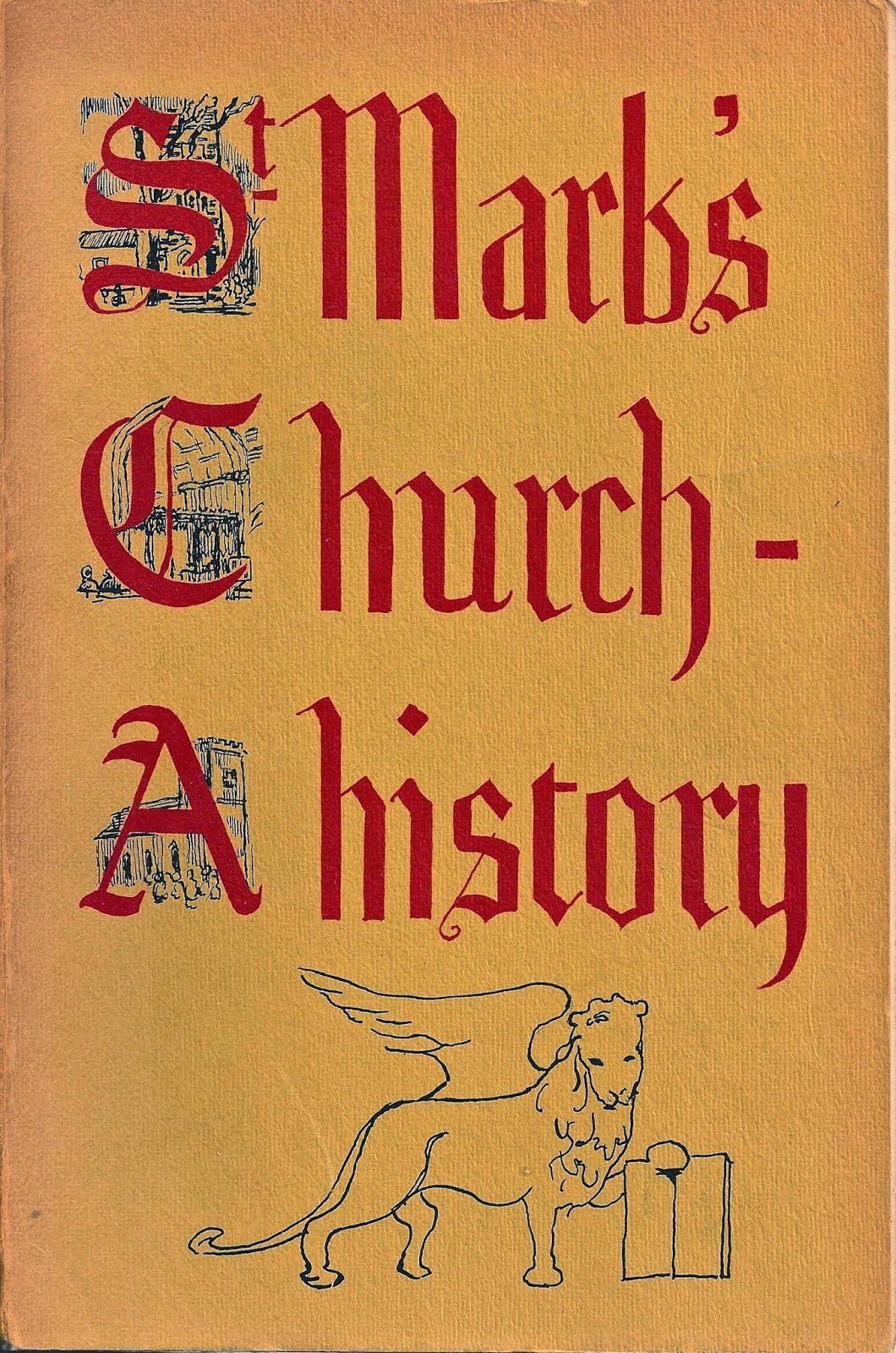
St. Mark's Church: A History

Front Cover
One of the first sources we consulted on the history of the St. George's/St. Mark's Cemetery was St. Mark's Church: A History by Helena Rutherfurd Meade. This lovely little book is excellently written and researched and is beautifully illustrated by B. Shirley Carter. It contains an introduction by the Rev. Phil Porter Jr., the rector of St. Mark's at that time. In her acknowledgments, Mrs. Meade writes:

"Without Mr. Herbert Barber Howe's scrapbooks (in the possession of his son, Mr. David F. R. Howe) and his notes and articles on Saint George's Church, the early days of Saint Mark's Church and on Canon Prichard, the history would have been poor indeed." As you may know from this blog, at least one of the Rev. Howe's scrapbooks made it into to the historical society's collection, where I recently accessed it and transcribed it (read the full story here).

She also mentions "Mrs. Daniel Forgea" who "turned over to me her superb scrapbooks of [the town], from which, and from her memories, I learned much." Mrs. Forgea, known to my mother as Aunt Glynette, was the best friend and neighbor of my great-grandmother Ruth. This is a photo of the Forgeas (on the left) with my great-grandparents (on the right) in 1924.

Below, I have copied some select passages from the book that were of interest to me - for various reasons - and may be of interest to others.

Inside Cover
On the building of Old St. Mark's:
"Prior to the building of the new Church, it was necessary to obtain permission to build from the Vestry of Saint Matthew's Church, Bedford who were the successors of the original incorporation (i.e. Saint George's). This was granted in 1852, so Saint Mark's was built on the spot, but slightly behind where once stood Saint George's of Revolutionary background" (16).
On St. George's and St. Mark's:
"Neither church was large, although, at some later date, a steeple with a belfry was added to Saint Mark's but when, has not been established. Also, at some time later, a lych gate was added to the grounds at the opening of the stone wall where the walk to the church began. ('Lych' is old English, and means corpse.) This one seems to have been American Rustic in style, not English Gothic. In England at the entrance to most early churchyards, the lych gates were used to rest the coffins and the bearers before the final march into the church" (16). 
On the frustrations caused by vestry minutes:
"Vestry minutes can be as innocent, as cryptic and as secretive as are, often, the minutes of corporations, and the more there seems to have happened, the less appears in the minutes. Only by close study of many years, and, even then, only by having the genius of a ferret, is it possible to learn what actually happened" (17-18).

"Minutes are very scarce and very sketchy documents in the early days of Saint Mark's. Only a few scattered ones are in the Parish scrapbook. This scrapbook is a catch-all of all sorts of valuable and/or curious papers that actually go back to the Articles of Incorporation of 1850. There are letters of resignation of Rectors, and others as well, and it is fortunate there is even the little that there is" (20).
 On disagreements surrounding the building of New St. Mark's in the 1910s:
"But, alas, a few, not too many, but a very nice few could not fall in with the Rector's and the architect's and ultimately the Vestry's choice, so they resigned from the Church and went to Saint Matthew's in Bedford. Isn't it the same old story? People must have their own way, and how often it happens in a Church! Those who go may not realize how hurt are those who remain, and, of course, how it hurts God's body! Never leave your Church because you disagree with a decision that has been fairly made. We are all members of one another. Ephesians 4:25" (39).
On the donation of Old St. Mark's to the St. Francis A.M.E. Zion Church (notice that Mrs. Meade could only say how the vestry voted - not what actually happened!): 
Illustration of New St. Mark's
"In 1915 came the death knell of the old Church in the burying ground at New Castle Corners. The vestry voted to wreck the building; then they voted to give the timbers to The African Methodist Zion Congregation for building a church and to pay for their moving" (52).
On the contents of Old St. Mark's that were transferred to the chapel of New St. Mark's:
"Here it might be well to mention the gifts in the Chapel. These were all originally in the Church at New Castle Corners and were given either by the Cowdins or their kin and are in memory of members of the Cowdin family. These include the Altar, two Tiffany glass mosaics once the Reredos in the old Church, now on either side of the Chapel, the three windows, all, it would seem, Tiffany windows and the memorial tablets. The Altar rail was given by Mrs. Henry Marquand for the first Saint Mark's and moved from there" (63). 
On the Rev. Prichard's influence on Herbert B. Howe (he did convert him, after all!):
"Mr. Prichard's influence on Mr. Howe brought him into the Episcopal Church. Their letters show great warmth and love and understanding between them. In 1944 he became a lay reader and during the Canon's illness he conducted a large number of the services at Katonah. This relieved some of the heavy pressure on the Clergy. The lights over the lectern in Saint Mark's, where he read the lessons so often, were installed in his memory by his son" (76-77).
And lastly, on the cemetery and Mrs. Brundage (I wonder who was privileged with the task of breaking this to her):
"In 1898 it was voted that Mrs. Brundage be asked not to use the cemetery any longer as a thoroughfare" (28).
Mrs. Meade's signature: "How far this little candle throws its beam"
Mrs. Meade was quite an interesting person herself. I did a bit of research on her for the exhibition, as her book is featured in it. Born Helena Rutherfurd Ely in Vernon, New Jersey, she married Richard Worsam Meade IV, a veteran of the Spanish-American War and transportation entrepreneur, in 1905. They joined St. Mark's in 1913.

Mrs. Meade's mother, also named Helena Rutherfurd, was a founding member of the Garden Club of America and the best-selling author of A Woman's Handy Garden (1903).

Mrs. Meade's other books included The Story of the Bedford Garden Club (1955) and A Garden and a Book (1951), a memoir about her mother's career.

Sunday, January 19, 2014

St. Mary's Church, Bedford

Several decades after the Revolution, certain parishioners of St. George's Church felt that the church building had been damaged beyond repair, having alternated between complete abandonment and occupation by thousands of troops over the course of the war. The vestry decided that the money left by St. George Talbot (the original benefactor) would be better spent securing a location for a new church than repairing the old one. In 1810, St. Matthew's Episcopal Church was built in Bedford. Forty years later, St. Mary's Church was established as a mission church of St. Matthew's to serve the population living on the outskirts of the town.


As those of you who have been following this blog for a while may be able to recognize, this little church represents the same basic model for a "country church" of the 19th century epitomized by Old St. Mark's (1852) and St. John's of Tuckahoe (1798). You will see this exact type of church replicated all over the Northeast United States.

What makes St. Mary's Church special for us is its connection to St. George's/St. Mark's. St. Mary's might be considered a "granddaughter" of St. George's, and St. Mark's is perhaps ... a reincarnation of or heir to St. George's? Regardless of what metaphors you use, it's clear that 1) St. Mary's and St. Mark's share a common lineage, and 2) their histories were similar - the former built in 1851, the latter in 1852, both built to serve  a small population of mainly farmers.


Sometime in the late 19th century, however, the histories of the churches diverge. While the town around St. Mark's grew, leading to increasing numbers of parishioners, St. Mary's remained - and still is - a country church serving a small congregation (while at the church I happened to run into a member of the vestry, who told me that about 25-35 people attend St. Mary's, which is only open a few times a year*). You can see from these photos that the landscape around St. Mary's is still quite rural and very beautiful, whereas the St. George's/St. Mark's Cemetery is pinned between a parking garage and a bagel shop.

In fact, the forces that would transform the town around St. Mark's into a suburban center were already in place by the time the two churches were built. The railroad came to the town in 1847, providing direct access to New York City. Bedford is not on the railroad line. The growth in the St. Mark's congregation would ultimately lead to the construction of a new church closer to the center of town.


This image might be interesting to those of you who have participated in and/or followed the dig. This part of the church was most likely an addition made after its original construction in 1851, so I can't say how old it is. But look at the size of the rocks in the foundation. Aren't they enormous? They are about the same size as the large quarried boulders we found in Feature 1 and Feature 3. They are not shaped - meaning that they haven't been cut into a more manageable shape, but rather have been used pretty much "as is," with the smaller rocks fitted around them. Now imagine if the foundation walls toppled over and were left there for 100 years. We might very well expect to find something like what we observed in Features 1 and 3. But let me know what you think.

*Special thanks to vestrywoman Ms. W for answering my questions about St. Mary's Church.

Thursday, January 16, 2014

What Light Can Do


The last few times I visited the cemetery, the gravestone of Benjamin Dutcher was illegible. Yesterday, however, the light was just right, and I was able to read his stone. You can see the old iron-wrought gate to the cemetery in the background of this photo.


This stone, commemorating the two children of William and Elizabeth Brown, was also perfectly lit, revealing the beautiful rose bush at the top.


Urn and willows are usually difficult to see. Most of them date to the 1830s-1850s, and were produced in marble. Both of these factors make for very poor preservation. But yesterday the stone of Ann Eliza Sarles looked great.


Though I had photographed the stone of Hannah Searles Wright before, I had never noticed the little rivulets around her name.


Lastly, here's the grave of Parthenia Sarles, newly reset by the boy scouts.

Wednesday, January 15, 2014

Mysteries


Today I added 62 new memorials to the cemetery's Find A Grave page. I was also able to identify some graves that weren't on my transcription - either because I missed them in the Eaderley transcription, or Eaderley did! For example, this stone in the Methodist cemetery - Underhill S. Hall.


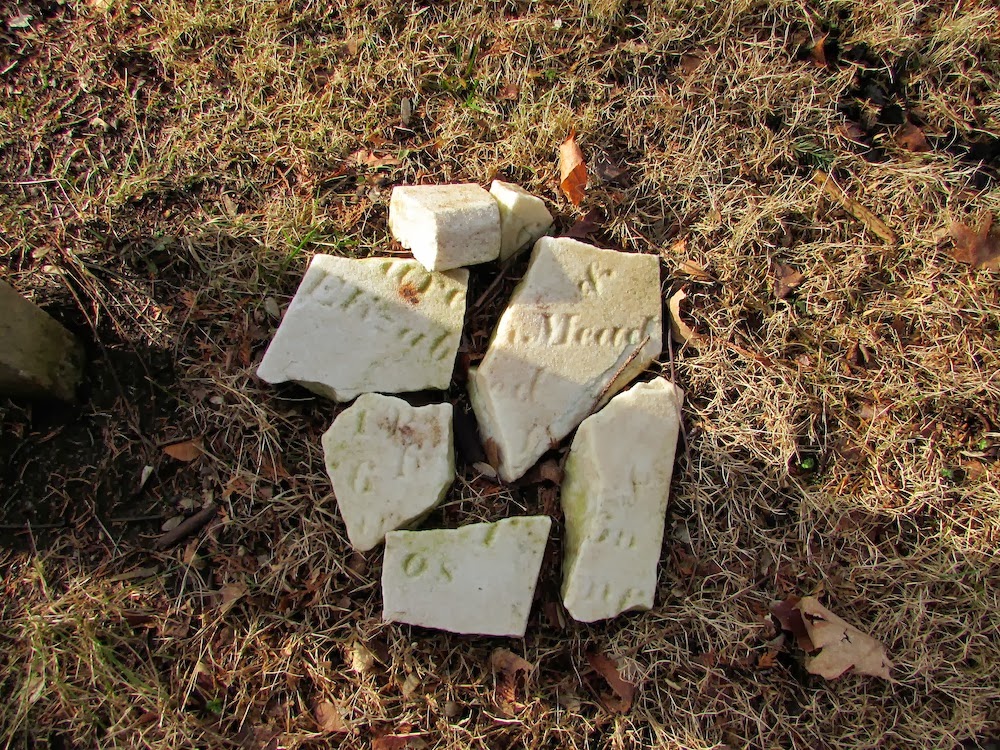
Thanks to the Eaderley transcription, I was able to identify the fragments below. They were part of the gravestone of William H. Mead, son of Jared and Elizabeth Mead, who died on July 9, 1836 at the age of 1 year and 6 months.


I couldn't do the same for this stone. It may be too far gone. I don't know what made it break down so badly - perhaps it's been lying on the ground for a long time, letting water gather on it.


Every time I go to the cemetery I find another mystery. Take a look at this stone - Thomas Seaman. For one thing, it's not in the Eaderley transcription, but that's not what's weird about it. Why is there no exact date of death ("July 1868")? Why was he "Buried at White [Plains?]." I will have to investigate this.