Sunday, November 17, 2013

The Story Behind Solomon

"Solomon" is my name for the cherub face I've used informally as a logo for the dig. The name comes from Solomon Brewer, the gravestone carver who created the design the logo is based on. Seen on the grave of Robert Craft, who died in 1793, it features a winged cherub face with a crown.

Laurie used this design in the sign for the cemetery restoration and archaeological excavation:


This is another Solomon Brewer stone from the cemetery, with a slightly different crown.

We have seen this same design featured on stones in many different cemeteries, and I think it's fair to guess that all or most were created by Solomon Brewer (or at least his workshop). The University of Chicago has an online gallery of Solomon Brewer's work in New York. It turns out that many of the cherubs that Laurie and I admired in the Old Dutch Cemetery in Sleepy Hollow are Brewer's, including:

The triple stone of Cornelius, Jacob, and Winey Couenhoven, 1794. For a much clearer image (taken before the stone sunk into the ground), see the University of Chicago Gallery.

The double stone of Joseph and Susannah Youngs, 1780s.


The stone of Ann Couenhoven, 1797.

Perhaps the most impressive Solomon Brewer stone is the Hezekiah and Mary Day stone in West Springfield, Massachusetts. It's not only unlike any other Solomon Brewer stone - it's unlike any other stone I've ever seen, with elaborate portraits of the husband and wife facing one another.

Saturday, November 16, 2013

Announcing St. George's Excavation Merchandise

Have you always wanted your own tote bag with a design based on the work of eighteenth-century gravestone carver Solomon Brewer? Of course you have!

For weeks now I've wanted to create a sort of souvenir for the dig for all the people who worked on it. I thought about getting everyone a tote bag, but it turns out I don't have the money for that. The next best thing I could do was design at tote bag and offer it to anyone who would like to have one at the cheapest price. Through CafePress, I was able to create a variety of products that are now available for sale.

By using CafePress, I can offer these items at no cost to myself. I also don't make any money from it. The price of the item is the exact amount charged by CafePress to produce it.

In the future (and if there is enough interest), I could increase the price of the items and use the proceeds to fund future excavation work. For now, though, I wanted to make sure that everyone who has participated in the dig or followed its progress online has a chance to get something at the lowest possible price.

I also have some ideas in mind for an "Adopt a Gravestone" or "Adopt a Feature"-type fundraiser. Other cemeteries in this area have used this approach and had some success.

Lastly, over the winter I will also be looking into grants offered by various institutions for our continuing excavation and artifact processing ... but since there are no t-shirts involved in that I probably won't be posting about it.

Along with the tote bag above, these items are available for sale:

http://www.cafepress.com/stgeorgesexcavation

Men's and women's organic t-shirts

http://www.cafepress.com/stgeorgesexcavation

Sigg water bottle and stainless steel travel mug.

You can click on any of the links above (or the images) to go to the store. If there's any other item you'd be interested in, let me know and I may be able to create it. CafePress has pretty much everything.

Thursday, November 14, 2013

Field Day 23


This is how we spent the morning - backfilling trenches lined with plastic wrap. Why? Because when we got to the site, the tarps over the trenches looked like this ----->

Ice! The cold season has officially arrived. But why plastic wrap? We wrapped Features 1 and STP 3/Feature 4 in order to return to them next season. Feature 4, when filled in, looked creepily like a grave. I hope no one calls the police on us again.

This is what STP 3/Feature 4 looked like before we filled it in. We think this may be the corner of a foundation wall. Where we had thought it might continue, it turns abruptly and disappears outside of the unit - how sneaky! But it works out just fine for us, because a corner gives us more information on the location of the church than a random section of wall.

And here's Bruce, Bill, and I convened in Feature 1 before we filled it in. We were discussing the artifacts found beneath those big boulders I'm sitting on and how they might have got there. Did the artifacts slip under the boulders, or did the boulders fall on them (perhaps when a church wall collapsed)? Bill and Bruce think that the boulders are part of a foundation wall.


While all of this was going on, Bruce and Angelika were busy metal detectoring along the southern wall of the cemetery. They made some great finds, including pieces of what seem to be a lead box, a sleigh bell, and an Indian head penny from 1887. But perhaps the most exciting find was this, found by Bruce:


We knew that it was a King George coin, but which George? After doing some research, my dad and I have come to the conclusion that it was George II (shown below). This was the only coin with both a left-facing bust on the obverse and a left-facing Britannia on the reverse (Georges I and III face right). As for the date, I looked at it very closely when I got home and thought I saw the year 1727, but my dad couldn't see it. (The details on the obverse of the coin are actually much clearer in the photograph above, which I didn't see until later, than they are in real life. Looking at it now, I can see the number "II" and the word "REX" on it).


While he was digging at a different spot, Bruce came across this gorgeous spout from an earthenware teapot. Impressed by this find, Laurie decided to dig a little more to see if she could find the rest of the teapot. What she found were several more pieces ... and a privy.


Yes, a PRIVY. One generation's toilet is another generation's archaeological treasure trove. Why? Because in addition to what you'd expect people to find in a toilet, you can find bottles, jars, pots, nails, metal objects, combs, eyeglasses, buttons, teacups, pipes, animal bones, shoes, and whatever else people felt like dumping in there because in the eighteenth and nineteenth centuries there was no trash collection service.


And so, for the next million hours that came after we backfilled Features 1 and 4, we dug the privy. We didn't have to dig very far - about twelve inches - before we had uncovered so many artifacts that I had to stop and just organize them for an hour. We were in awe of what we found. Just look at Tricia and Gretchen in the photo below - can't you see the awe?


The photo below shows a mere SAMPLE of what we found. Ultimately, the finds from Level 1 filled five medium-sized boxes. The most significant categories were ceramic, glass, metal, and bone/shell. The volume of ceramic sherds was most surprising to me considering that we have found so little ceramic in the other parts of the site we dug this season. Well, I guess I found where it was hiding.


Left: Another piece of the teapot (we found about four pieces of it so far). Right: The rim of a ceramic basin.


Left: An eyeglass lens (from the optical factory?). Right: What we think is the base of a lamp.


Left: A maker's mark on an earthenware sherd. I'm not a ceramics expert, but this thing is OLD AS DIRT. Right: Pieces of a glass bottle that Laurie identified as "The Great Universal Stomach Bitters," c. 1870s-1880s. You can see a photo of an intact bottle here.

Here are some more ceramic pieces with printed designs. The largest piece was manufactured by the East Trenton Pottery Co. in Trenton, New Jersey, in the late 1880s.


There's more that we didn't even get a chance to take pictures of, but I think you get the general idea. As for how we were able to tell we found a privy - the large amount of artifacts was a clue, particularly the number of oyster and clam shells (which were used to kill the smell in privies). As we dug deeper, we realized that the hole we had found was lined with stones. I also realized that I will be processing artifacts ALL winter ... which actually sounds pretty wonderful.

Tuesday, November 12, 2013

Hill Cemetery, Putnam County

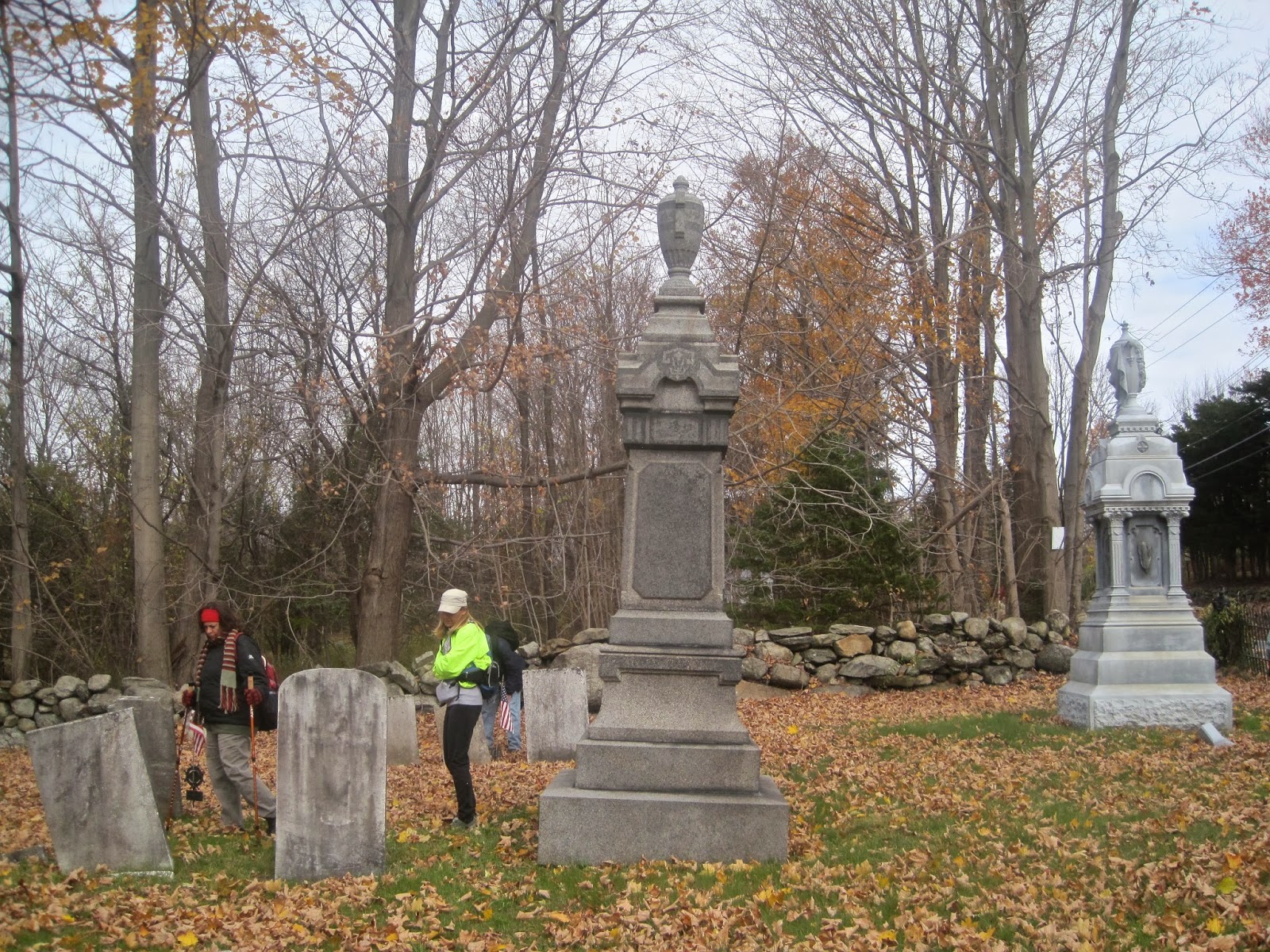
About a week ago we visited the very historic Hill Cemetery in Putnam County as part of a walking tour. The cemetery is the final resting place of members of the Hill family, including William Hill, who served in the local militia during the French and Indian War, his mother, and his descendants. The cemetery is also notable for its several large Gothic monuments, of which quite a few are "white bronze" or zinc. I had never seen such large zinc monuments before.

As you can see in the picture below, the same style of monument is represented in granite (left) and zinc (right). The zinc monument would have been several times cheaper than the granite, and preserves remarkably well. Zinc first became popular as a gravestone material in the late nineteenth century and stopped being used with the onset of World War I.


Some of the zinc monuments had corn and sheaves of wheat on them, a testament to the Hill family's occupation as farmers. You can see in the right photo how the panels of the monument are bolted into place, allowing for customization of each side.

The inscriptions and designs in zinc monuments are extremely crisp and clear. At this point I probably sound like an advertisement for zinc monuments, but if you were used to straining to read marble gravestones, you'd understand my appreciation for them. They certainly look great at a hundred years old. Whether they'll look this great at 200, 300, or 1000 is another story.

Below are the gravestones of William Hill, the French and Indian War veteran. The undressed fieldstone marker on the right is inscribed with Hill's initials. The marble monument in the center was added in the nineteenth century by his descendants and commemorates Hill and his wife, Bethiah.


This Hill descendant was a Free Mason. I have been intrigued by the Free Mason symbol ever since I first saw it on my great-grandfather's grave marker. For those who are interested, here is an explanation of what the G means.


Here's a general view of the cemetery showing the old stone wall and the grave of William Hill. The family's original eighteenth-century house was located nearby; their nineteenth-century house still stands and is, I believe, where Laurie saw this 1843 doorknob (I wasn't there for that part of the tour).


And one more view showing the amazing zinc monuments. While they're not really to my taste (I would like to have an eighteenth-century, Solomon Brewer-style sandstone gravestone with a crowned cherub like that of Deborah Haight, which spells out my exact age down to the day and used the abbreviation AE.) I think they're wonderful. I like the irony of Victorian excess being expressed in such a utilitarian form, and of Gothic architectural styles being expressed through industrially produced materials. Plus the noise - clang! clang! - when you knock on them. They're just great.


Monday, November 11, 2013

Field Day 22

It was an exciting day for the excavation team. The photo above shows Hand Pestle #1 (right), which we found several weeks ago, and Hand Pestle #2, which was found today by our youngest excavator. Actually, he found half of the pestle (it had been broken in two). We found the other half several hours later. I am quite certain that it is a pestle, given the distinctive indentations on either side, the pocked surface of its narrowest point, and the way it feels in my hand. Of course, I am not an expert on stone tools and in fact, Hand Pestle #1 is the first hand pestle I had ever seen - but I just have a feeling about it!

Here's another picture of the Pestle #2, showing the break:


For those of you keeping track, Hand Pestle #1 was found in Feature 1 (a.k.a. the Dry Well a.k.a. the Dump a.k.a. What Is It?!) while Hand Pestle #2 was found in Feature 4 (a.k.a. STP 3 wall extension).

The find below, made by Laurie in Feature 1, is the largest piece of painted plaster we've found. Like the hand pestle, it's broken into two pieces, but they fit together (and unlike the hand pestle, they were found side by side).


The paint is easier to see on this piece of plaster (below), also unearthed by Laurie. All in all I think she dug up about 3 pounds of painted plaster today, more than doubling what we had already had. While most of the pieces seemed to show different layers of a single color (pink over blue over orange, etc.) one or two had a clear design on it. All of the pieces are currently being treated in my high-tech conservation lab (i.e. they're being air-dried in a box in our spare room).


Today was also exciting because we received a visit from the press. Journalist Ned and photographer Joe came by and asked us questions about the dig. Here's Ned talking with Susan in Feature 1:


And here I am showing him some artifacts. He especially liked the belt buckle. Hopefully I did a good job representing the group. Some very valuable members of our group couldn't be there (it is Monday, after all), which was too bad! I am not the most eloquent speaker but I'm extremely proud of our work and have great affection for this site, which I hope comes across in the article.


Luckily, a lot of very valuable members of our group did make it and worked hard in spite of the cold (which was not so bad today). Laurie, Susan, and Tricia took on the challenge of contorting themselves between the boulders of Feature 1 to dig, while Gretchen recorded.


Gretchen also helped with screening, but I have to admit I like this picture mostly because of her hat! I've made similar cable and bobble hats and was wondering if I knew the pattern. And speaking of screening, I thought it was hilarious that every bucket of dirt we screened all day was full of artifacts ... except when the journalists were here. During that time the artifacts completely stopped coming. My narration could have been, "And this is the shaker screen, where we play with rocks and worms." Oh well!


Some non-archaeological members of the team were there too, like Hans, who took care of some of the millions of leaves that have been flying into the units nonstop ...


... and the Cornells, who are repairing stones. Here's Charles Haight's stone in the process of its repair ...


... and here's Isaac Lounsbury's. I'm really looking forward to seeing how these stones come out. The results so far have been amazing.


Here's one last shot of the cemetery to end the post. I can't believe that we're almost done for the season. The two big trees we've been enjoying for weeks have lost all of their leaves! Before we know it the whole place will be covered in snow.

Saturday, November 9, 2013

Field Day 21

Whew, it was cold today. The temperature isn't really that low (about 45 degrees F), but over the course of hours it makes it very difficult to use your hands properly. You can tell how cold it was based on my handwriting on the forms and bags - and by the bags, which seem to rip easier when they're cold.

Still, we got a lot done, finishing Level 2 of Feature 4 and uncovering a few nails and a huge amount of painted plaster from the northwest corner of Feature 1 - shown below. The colors of the paint so far have been pink, blue, black, gray, and red.  I am starting to imagine a whole landscape painted across the church walls! (But which church? That is the question.)


Feature 4 produced the same sorts of artifacts we have already found in the unit: nails, pottery, glass, slate, coal, and mortar. The northwest quadrant of the unit continues to show signs that the wall from STP 3 extends beneath it. We shall see!

Meanwhile, history enthusiast and former local resident Bruce did some work with his metal detector around the cemetery. In case you're wondering, all the finds our metal detectorists make are bagged and labeled with the find location and date.


Finds like this shoe buckle, for instance, which is made of bronze and probably dates to the Colonial Era. It was three inches below the surface of the ground. Bruce also found several square nails.


The surface surveying team, represented today by J, also made some impressive finds. Below, we are organizing them in order to take photographs. Again, there was a good mixture of material from the mid-nineteenth all the way up to the twenty-first century.


With Field Day 21, we have now been excavating the equivalent of three whole weeks! Or the equivalent of four five-day weeks plus one day. We now have a whole new understanding of the site, a million new questions, and I have a new respect for people who work outside in the cold. It's not easy - and it isn't even that cold yet!

Next week, depending on the weather, we may close up the site for the season and begin cleaning, writing, and artifact processing. Once the trenches close, the real work begins.

Thursday, November 7, 2013

Field Day 20


Well, it was a rainy but not at all unproductive day at the site! Above you can see Jenny, Tricia, and I working on Level 1 of Feature 4, which we were able to finish despite the rain (the pink umbrella is covering our recording forms and artifacts). We were even able to make a few notable finds, such as the shard of glass below, which has either an etched or painted design on it (although you can't really see it in the photo).


You may recall that Feature 4 is an extension of STP 3/3A/3B/3C. I have my own highly sophisticated process for labeling all the units, which is called "Making it up as I go along." Next season I am considering giving the units names like Mary and Tom. Or maybe Louis A. Brennan. When it comes down to it all of these designations are arbitrary, although I have tried to use some logic in creating them so that people in the future who look at our records will be able to tell what we were thinking. As long as everything is recorded properly, I figure we'll be all right.

In addition to working on Feature 4, we were able to backfill Feature 2, a.k.a. the corner of that weird rectangle of stone pillars from 1964. We kept the part of a pillar that we removed from the unit outside of the filled-in trench, but for now it's staying on the ground where it is. It's an artifact, but a really heavy one.


When it began to rain harder, we were forced to close the unit for the day, pack up our stuff, and go home. Excavating in the rain is really messy, and I think we all got covered in mud, but it was pretty warm and pleasant when it wasn't raining (incidentally, it's forecast to snow next week).


On a final note, I'd like to thank the Rockland-Bergen Postcard Club in Pearl River for having me as a speaker last night. I gave a presentation on the history, restoration, and archaeology of the cemetery, and shared some artifacts from the site and some postcards showing views of the town. I had a great time and gained some valuable experience in public speaking, which I hope to do more as we share our finds with the community.