Tuesday, July 9, 2013

Life Expectancy in the 19th Century

Using the new life tables created by J. David Hacker, I put together these charts in order to compare the life expectancy of people in the cemetery with the overall life expectancy of the white population of the United States. I excluded the decades before 1830 because there wasn't enough data available from the cemetery. Here are my results for male life expectancy at birth and female life expectancy at birth.


As you can see, all four sets of lines share the same general trend: a dip in the middle, followed by gradually increasing life expectancy over time. The lines in each chart also have the same relationship to one another. That is to say, in both of these charts, the cemetery has lower life expectancy than the new life tables in the earlier decades but reverses later on, so that the cemetery has higher life expectancy than the new life tables.

Now compare this with male and female life expectancy at the age of 20. Again, the same general trend is visible: a dip in the middle of the century, with steadily increasing life expectancy from the 1870s on. The cemetery also shows lower life expectancy than the new life tables at the beginning, but overtakes the new life tables towards the end. Notably, it is much later in the century that the cemetery begins to show greater life expectancy - in the 1870s for men and not until the 1890s for women, whereas in the tables for life expectancy at birth, the trend had already reversed by 1870.

Also notable is the fact that the 1860s seem to have been a bad time for everyone, but especially men and especially men buried in the cemetery.


It would seem that for much of the nineteenth century, people at the cemetery died younger than average. Then, in the 1870s, as general life expectancy increased, the life expectancy of people in the cemetery increased even more, overtaking the national average. For both the cemetery and the national population, 1870 seems to have been a turning point, after which longevity greatly increased, and continued to increase.

I don't know how to explain why the people in the cemetery seem to have shorter lifespans than average. Was this an accurate reflection of the longevity of the congregation, or of the local population? Are the numbers skewed by the relatively small sample size, or by my methods of data collection? How might they compare to other cemeteries in the area?

Much more research is needed!

Source
Hacker, J. David. "Decennial Life Tables for the White Population of the United States, 1790-1900." Historical Methods Vol. 43, No. 2 (April 2010): 45-79. 

Mortality at the Episcopal Cemetery


After reading the article "Applying Archaeological Techniques to Conserve a Historical Cemetery in Ripley, Maine" in the Maine Archaeological Society Bulletin (thanks, Laurie!) I wanted to make my own chart to show the ages at which people in the cemetery died and track them across time. The chart above is based on the 1909 transcription and my own research drawn from the stones themselves, obituaries, censuses, etc. The chart represents 398 individuals. Twenty two individuals were excluded from the chart due to the fact that their age at death could not be determined. Also, my data for the 20th century is not as complete, so the latest burial included in the chart is from 1906.

I should note that infants for whom no age was given (some graves simply say "Infant") were automatically given the age of 0.5 years, as were any infants who were less than one year old, for the sake of the chart.

Looking at the chart, it's difficult to distinguish any sort of pattern, aside from perhaps a general drift towards greater longevity over time. It's easy to see that more people were buried in the cemetery after 1820 than before, but the age at which they died at any time seems almost random, with one exception. There is a huge cluster of child deaths in the mid-19th century, particularly between the years 1845 and 1870.

The next thing I wanted to do was to break down age at death by gender. The following charts represent 199 male burials and 198 female burials. One infant was excluded because his/her gender could not be determined. One person who was identified by initials only (C. H. Purdy) was assumed to be male.


Again, it's somewhat hard to make out a pattern. I expected that more women than men would die in their 20s and 30s due to complications of childbirth and pregnancy, but that doesn't seem to be the case. There does seem to be a small cluster of deaths of men in their 20s around the year 1860, perhaps reflecting Civil War fatalities.

Life Expectancy at the Cemetery
The most important thing to remember about average life expectancy is that it can be misleading - more so in the past than it is today. Because children died so frequently, life expectancy at birth was low throughout the 18th and 19th centuries. However, as soon as an individual made it out of childhood, his or her life expectancy increased significantly. This pattern is reflected in the average life expectancy of people buried in the cemetery.

To begin with, average life expectancy at birth for all 398 individuals included in this study was 42 years. For the 199 males, it was 40.8 years, and for the 198 females, it was 43.5 years.

Once a person reached the age of 10, average life expectancy was 53 years (54 for women and 51 for men). Once a person reached the age of 30, average life expectancy was 61 years (62 for women and 60 for men). Once a person reached the age of 60, average life expectancy was 74 (74.5 for women and 73.6 for men).

Of 398 burials, 21% were children below the age of ten, and 30% were adults over the age of 65.

Life Expectancy Over Time
By calculating and plotting average life expectancy at birth for each decade, it's easier to see the trends in mortality at the cemetery over time. The following chart shows the average life expectancy of people buried at the cemetery between the years 1773 and 1906. The numbers for the early decades (1770s, 1790s, 1800s, and 1810s) are distorted due to the fact that there were so few burials (and none in the 1780s). Beginning in the 1820s, the numbers are more likely to reflect reality.


To shed light on the important factor of child mortality, I made this graph, representing the percentage of children under 10 years who were buried in the cemetery each decade.


Again, the first few decades of this graph are distorted due to the small number of burials, but after 1820 are more accurate. It seems that child mortality was very high in the mid-nineteenth century, averaging around 1/3 of burials between 1830 and 1860, but it dropped off dramatically in 1870.

Below, you can see the numbers I used to create the charts above.

1773-1779
Two burials; average life expectancy: 62.5 years
0% under the age of 10 years
50% over the age of 65 years

1780-1789
No burials.

1790-1799
Nine burials; average life expectancy: 38 years 
33.33% under the age of 10 years

1800-1809
Two burials; average life expectancy: 24 years
0% under the age of 10 years
0% over the age of 65 years

1810-1819
Three burials; average life expectancy: 52 years
None under the age of 10 years
33.33% over the age of 65 years

1820-1829
Twenty burials; average life expectancy: 38.9 years
15% under the age of 10 years
20% over the age of 65 years

1830-1839
Thirty burials; average life expectancy: 31.4 years
33.33% under the age of 10 years
16.67% over the age of 65 years

1840-1849
Forty burials; average life expectancy: 37.9 years
32.5% under the age of 10 years
25% over the age of 65 years

1850-1859
Sixty-eight burials; average life expectancy: 33.7 years
33.8% under the age of 10 years
22% over the age of 65 years

1860-1869
Seventy-five burials; average life expectancy: 31.6 years
33.33% under the age of 10 years
18.7% over the age of 65 years

1870-1879
Sixty-one burials; average life expectancy: 50.6 years
6.6% under the age of 10 years
37.7% over the age of 65 years

1880-1889
Forty-three burials; average life expectancy: 50.8 years
14% under the age of 10 years
37.2% over the age of 65 years

1890-1899
Twenty-eight burials; average life expectancy: 65.2 years
0% under the age of 10 years
60.7% over the age of 65 years

1900-1906
Sixteen burials; average life expectancy: 66 years 
0% under the age of 10 years
56.2% over the age of 65 years

Conclusions
If I were to do a proper scientific study of mortality at the cemetery, I would want to fill in the missing data by transcribing graves erected after 1906 and by conducting research on the 22 individuals who were excluded from these charts in order to determine their ages at death. I would also try to find a way to control for the discrepancies in the number of burials each decade; obviously, the fact that burials were few to begin with and tapered off toward the end is bound to distort these sort of calculations.

There are also historical and cultural factors to consider. How did war, epidemics, immigration, industrialization, religion, familial ties, social class, ethnicity, and interpersonal issues affect who was buried at the cemetery and when? How did the lives of the two churches on the site affect the life of the cemetery?

It's possible to take a guess at the latter question. Burials were few during the years that the first church stood, due to both the low density of people in the area and the Revolution. After the war, the cemetery didn't see a significant rise in burials until the 1820s and 1830s. During this time, the congregation was growing, but the church had been damaged by the war and wasn't used. The second church was built in 1852 to accommodate the growing community, and perhaps because of its construction, the cemetery continued to see more and more burials.

My next step will be to research mortality rates in nineteenth-century New York to see how they compare to the figures I have calculated for the cemetery.

Monday, July 8, 2013

The Church c. 1890


Once in a while I like to paint in watercolor, so yesterday I thought I'd paint the church - the second one, built in 1852, which stood until 1911. I based the majority of the painting off of this postcard, but since the trees obscure the view of the top of the church in that picture, I based the steeple on this photograph. That may be why the perspective looks a little off ... the bottom of the church looks like it's seen from below, while the steeple looks like it's seen from above. Oh well.

Since neither of those pictures is in color (the postcard had color applied after, which doesn't count) the colors in my painting are largely conjecture.

Sunday, July 7, 2013

Susan Montross

(Source)
Susan Ferris was born March 11, 1804, in Pines Bridge, New York. In 1823, she married David Montross, a farmer and the son of Nathaniel Montross and Hester Swarthout.

In 1850, Susan and David lived in Somers with their three children, Ann, Cornelius, and Julia, as well as Ann's husband William Acker, and a 10-year-old boy named George Leonard.

1850 US Federal Census
Susan died in 1852 at the age of 47, and was buried in the cemetery, probably because her Ferris family was buried there.

After his wife's death, David Montross lived with his daughter Julia, who had married Samuel Baker Reynolds, a laborer; Julia and Samuel's two children; and Charles and Mary Robertson, in Somers.

1860 US Federal Census
Ann Montross Acker moved to New York City, where her husband William worked in hardware. They had three children, two of whom (Eva and Susan) were alive in 1870, and one of whom was alive in 1900. The one surviving child, Susan, married George Mersereau and lived in Madison, New Jersey. In 1910, both William and Ann were living with the Mersereaus, who did not have any children.

Julia Montross Reynolds had three children: Daniel, Susan, and George, and died in 1879.

Cornelius Montross lived in Brooklyn with his wife Madeline and worked as a cartman. In 1870 they had three children: Annie, William, and David. Cornelius died in 1897.

David Montross died in 1891.

I find the patterns of names in this family to be very sweet. Both Ann and Julia named their daughters after their mother. Cornelius named his son after his father and his daughter after his sister. 

  1. Susan Ferris (1804-1852) m. David Montross (1804-1891)
    1. Ann Eliza Montross (1826-after 1910) m. William Acker (1827-after 1910)
      1. Eva Acker (1856-)
      2. Susan Acker (1834-) m. George Mersereau (1834-)
    2. Cornelius Montross (1828-1897) m. Madeline (1834-)
      1. Annie M. Montross (1858-)
      2. William F. Montross (1860-)
      3. David Montross (1867-)
    3. Julia Montross (1832-1879) m. Samuel Baker Reynolds (1834-1909)
      1. Daniel M. Reynolds (1856-)
      2. Susan A. Reynolds (1859-)
      3. George D. Reynolds (1863-)

A Sarles Family

(Source)
What is the relationship between these four Sarleses? By the way, did you know that there are five Thomas Sarleses buried in the cemetery? What, was the name Merritt not an option?

I'd like to take a moment here just to thank the volunteers at Find A Grave, which truly is one of the best free genealogy resources on the web. I like to have a photograph of the stone I'm researching, but if I've neglected to take one myself, I always go to Find A Grave to find one. They're fantastic! Not only are most of the graves in the cemetery covered already, but people continue to add stones to the database on a daily basis. You can tell how recently this photo was added by the posts and tape around Charles Haight's stone in the background, which have only been there since April. Find A Grave volunteers have been visiting the cemetery since our campaign began, adding photos not only of the stones, but of the signs we've put up next to them. They do great work.

Anyway, back to the Sarleses. Here are the names on the stone:

Leila May, died 1867
Mortimer S., died 1903
Harold, died 1904
Thomas H., died 1905

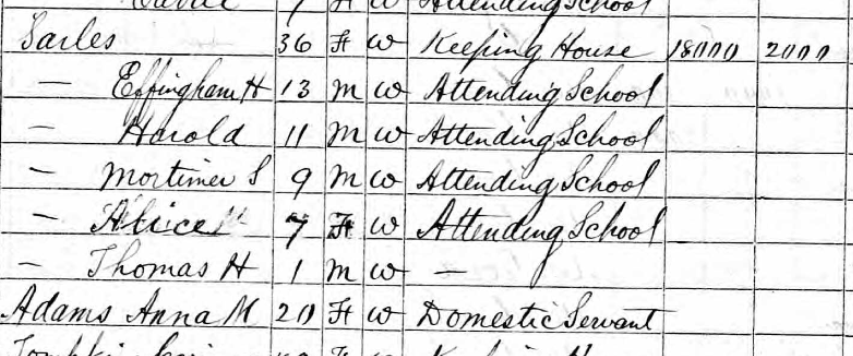
My first guess about these Sarleses was that they were a quartet of unmarried siblings, just like the Haines family. It turns out my suspicions were right on target. Here is the Sarles family in 1870. Note the presence of Harold, Mortimer, and Thomas (Leila would have died already). Also note that the census taker has neglected to fill in the name of the children's mother. I have called this census the Sexist Census before, due to the fact that the census-taker refused to list the first names of any married women, but instead listed them as "Mrs. [Husband's First and Last Name]." That is bad enough, especially considering that the 1850 and 1860 censuses do give the first names of married women, but look at this! Even when Mrs. Sarles is the householder, she doesn't get a name! And because her husband is dead, so she doesn't even get the courtesy of a "Mrs. [Blank] Sarles."

1870 US Federal Census
Thanks to the 1860 census, I know that Mrs. Sarles's husband's name was Thomas, probably the Thomas Sarles buried in the cemetery who died in 1869 at the age of 33, and that her name was Ernestine A. Hyatt.

Leila May Sarles isn't listed in the 1860 census. She was probably born between 1860 and 1867, and died as a child.

Harold Sarles didn't marry. In 1900, at the age of 40, he was living as a boarder in the house of his aunt, Catherine Hyatt, and her husband Oliver Van Cortlandt, and was listed as an "invalid." He died in 1904.

I might not have been able to identify Mortimer Sarles in the 1880 census, where he is listed as "M. S. Sarles," if it weren't for the fact that he was living in the same household as his brother would be 20 years later. While he lived with his aunt and uncle, 18-year-old Mortimer worked as a store clerk. 
He died December 16, 1903, in Jacksonville, Florida.

In 1910, Ernestine Sarles was living with her son Effingham, who was one of only two of her seven children still alive. At age 53, Effingham was listed as an "invalid," just like his brother ten years earlier. Did the Sarles children suffer from an inherited illness? Mother and son lived with three boarders at 339 West 50th Street.

1910 US Federal Census
During this time, Ernestine Sarles was embroiled in a court case regarding the estate of her "mentally incompetent" niece, Augusta Hyatt, which was estimated to be $400,000 (quite a sum back then). Ernestine died in 1911, leaving her brother Mortimer A. Hyatt and nephew George Hyatt Robinson as the last two relatives in the running. Ultimately George won.

Here's an article from the New York Times written when Augusta Hyatt was first declared insane.
New York Times 15 Dec. 1898
These articles, also from the times, announced George's victory over his uncle. Apparently George was a bit unstable himself, having been institutionalized by his wife in 1909 after an epic spending spree (seriously - he spent $500,000, the equivalent of 12.6 million dollars today, in 5 years).

New York Times 29 June 1912
New York Times 6 May 1914

  1. George E. Hyatt (1815-) m. Rachel (1821-)
    1. Augusta (1844-)
    2. Agnes (1847-)
    3. George (1849-)
  1. Thomas Sarles (1835-1869) m. Ernestine A. Hyatt (1834-1911)
    1. Effingham H. Sarles (1857-) m. Carrie G. Griswold (1860-)
    2. Harold Sarles (1859-1904)
    3. Mortimer S. Sarles (1861-1903)
    4. Alice Sarles (1863-)
    5. Thomas H. Sarles (1869-1905)
    6. Leila May Sarles (?-1867)
  1. Joseph Ryder Hyatt (1787-1848) m. Mary Pamela Montross (1796-1840)
    1. George E. Hyatt (1815-) m. Rachel (1821-)
      1. Augusta Hyatt (1844-)
      2. Agnes Hyatt (1847-) m. Charles Robinson
        1. George Hyatt Robinson
      3. George Hyatt (1849-)
    2. Jackson Hyatt (1819-1892) m. Phebe J. Sarles (1824-1909)
    3. Catherine Hyatt (1820-) m. Oliver Van Cortlandt 
    4. Oscar Warren Hyatt (1824-)
    5. Emily Hyatt (1826-1887)
    6. Mortimer A. Hyatt (1828-1916) m. Margaret L. Anderson (1827-1893)
    7. Minerva Hyatt (1830-1907)
    8. Ernestine A. Hyatt (1834-) m. Thomas Sarles (1835-1869)
    9. Pamela Hyatt (1838-1910)
    10. J. Effingham Hyatt (1840-1872)

Friday, July 5, 2013

Headstone of James Wright, Carved by John Zuricher


John Zuricher was a gravestone carver of the mid-to-late eighteenth century. He lived with his wife, Elizabeth Ensler, and their ten children in New York City, but produced gravestones that can be found across the Hudson Valley, Long Island, and New Jersey, and even in Pennsylvania and South Carolina. As a stone mason, he worked on New York City Hall and made milestones for the Albany Post Road.

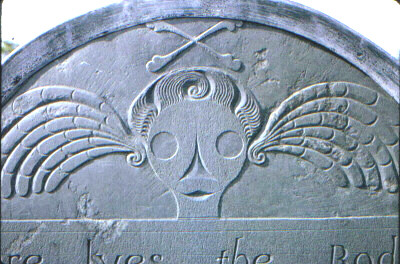
The stone in the photos above and below was created by Zuricher out of red sandstone for James Wright, who died in 1776. The decoration at the top is a round-faced cherub head with a crown of spiraling curls and quite distinctive wings, in which the feathers are laid out in a grid. There is also some sort of decorative flourish at the very top.

Anyone who has read James Deetz's masterpiece In Small Things Forgotten can tell you that there are three major phases of gravestone iconography in early New England and New York: death's head, cherub, and urn and willow. The cherub was a direct descendant of the death's head, and retained some of its features in a vestigial or reinterpreted state. For instance, that little nub of a chin at the bottom of the cherub's face evolved out of the jaw of the death's head - shown in this example. Furthermore, this stone represents the "missing link" between the death's head and the cherub.

It seems that Zuricher dealt exclusively in cherubs, which would make sense for the time period in which he worked (about 1749 to 1778). You can see more of his creations in this online gallery from Smith College.


Works Consulted:

Deetz, James. In Small Things Forgotten: An Archaeology of Early American Life. New York: Knopf Doubleday Publishing Group, 1996.

Ludwig, Allen I. Graven Images: New England Stonecarving and Its Symbols, 1650-1815. Middletown, CT: Wesleyan University Press, 1966. 

"Morbid Outlook: Identifying Gravestones in the NYC Area."

Veit, Richard Francis and Mark Nonestied. New Jersey Cemeteries and Tombstones: History in the Landscape. New Jersey: Rutgers University Press, 2008.

Clarence Perry


Clarence Perry, the three-year-old son of William and Alice J. Perry, died on May 5, 1885. I have had a hard time researching Clarence, for the following reasons:

-He was born and died in between census years, so I can't search his name.
-His parents have very common names, so I have difficulty searching for them, too. Plus, they don't appear in the two censuses that would be the most useful in identifying them: in 1880, they might not have been married yet, and the 1890 census is lost.
-He doesn't have any relatives in the cemetery ... or does he?

It occurred to me only after I put up this post that Clarence is grouped in the 1914 transcription with the Green family. Looking back at my posts on the Greens, I found that there was an Alice Green who was the daughter of John (1814-1896) and Mary Green (1816-1901) who are buried in the cemetery. Alice was born in 1847, which would make her about 35 when Clarence was born. Is she Clarence's mother?

I have not been able to confirm it. Maybe someone reading this can give me a lead!