Friday, September 6, 2013

Ann Proudfoot Masterton Bostwick Taylor

Graves of Monmouth and Rachel Meritt Miller
To the best of my knowledge, the woman whose gravestone bears the name of Ann Taylor married three times. She was born Ann Proudfoot, the daughter of Lawrence Proudfoot of New York City, around 1787. She was married for the first time on November 7, 1808, in the Reformed Dutch Church of New York City, to James Masterton. In 1823, she married widower Charles Bostwick. Charles died in 1824 while Ann was pregnant with their only son, Lawrence Proudfoot Bostwick. In 1835, Ann married William Taylor. When she died in 1860 at the age of 73, her full name would have been Ann Proudfoot Masterton Bostwick Taylor. This was the announcement of her death in the New York Times:
TAYLOR. -- In this City, on Sunday morning, April 8, in the 73 year of her age, ANN TAYLOR, daughter of the late Lawrence Proudfoot.
The friends of the family, and of her son, Lawrence P. Bostwick, are respectfully invited to attend the funeral, at the residence of her brother in-law, James Van Antwerp, No. 41 East 12th-st., at 3 o'clock on Tuesday afternoon. Her remains will be taken to Newcastle, Westchester County, for interment, on Wednesday morning.
Ann and Charles's son Lawrence married Mary Elizabeth Miller in 1850. Mary was a descendant of Reverend Francis Doughty, who migrated in 1639 from England to Taunton, Massachusetts, and later settled on Long Island, and the daughter of Monmouth Miller and Rachel Merritt, who are buried in the cemetery.

Lawrence and Mary had six children, two of whom - Mary and Maria - died when they were young and are buried in the cemetery.

Mary died in 1890, and Lawrence in 1900.

1890
I have tried to work out the various family trees that intersect through Ann Taylor. These are my results:

  1. Nathaniel Bostwick m. Sarah Holmes
    1. Charles Bostwick (?-1824) m. (1) Phebe Hubbs; (2) Ann Proudfoot Masterton (1787-1860)
      1. Henry Masterton Bostwick (1816-1852)
      2. Lawrence Proudfoot Bostwick (1824-1900) m. Mary Elizabeth Miller (1820-1890) in 1850
        1. Henry Masterton Bostwick (1843-)
        2. Ann Bostwick (1845-)
        3. Eliza Mott Bostwick (1847-)
        4. Mary Elizabeth Bostwick (1850-1851)
        5. Maria Proudfoot Bostwick (1853-1856)
        6. Eliza M. Bostwick (1862-) 

  1. Lawrence Proudfoot
    1. Ann Proudfoot (1787-1860) m. (1) James Masterton in 1808; (2) Charles Bostwick (?-1824) in 1823; (3) William Taylor in 1835
      1. Lawrence Proudfoot Bostwick (1824-1900)

  1. Jonathan Miller (1726-1792) m. Elizabeth Doughty (1728-1813)
    1. Monmouth Miller (1766-1836) m. Rachel Merritt (1784-1862)
      1. Mary Elizabeth Miller (1820-1890) m. Lawrence Proudfoot Bostwick
    2. John Miller (1768-1839) m. Phebe Pine (1771-1858)
      1. Sarah Elizabeth Miller (1809-1887)

    Tuesday, July 30, 2013

    Death's Heads in Manhattan


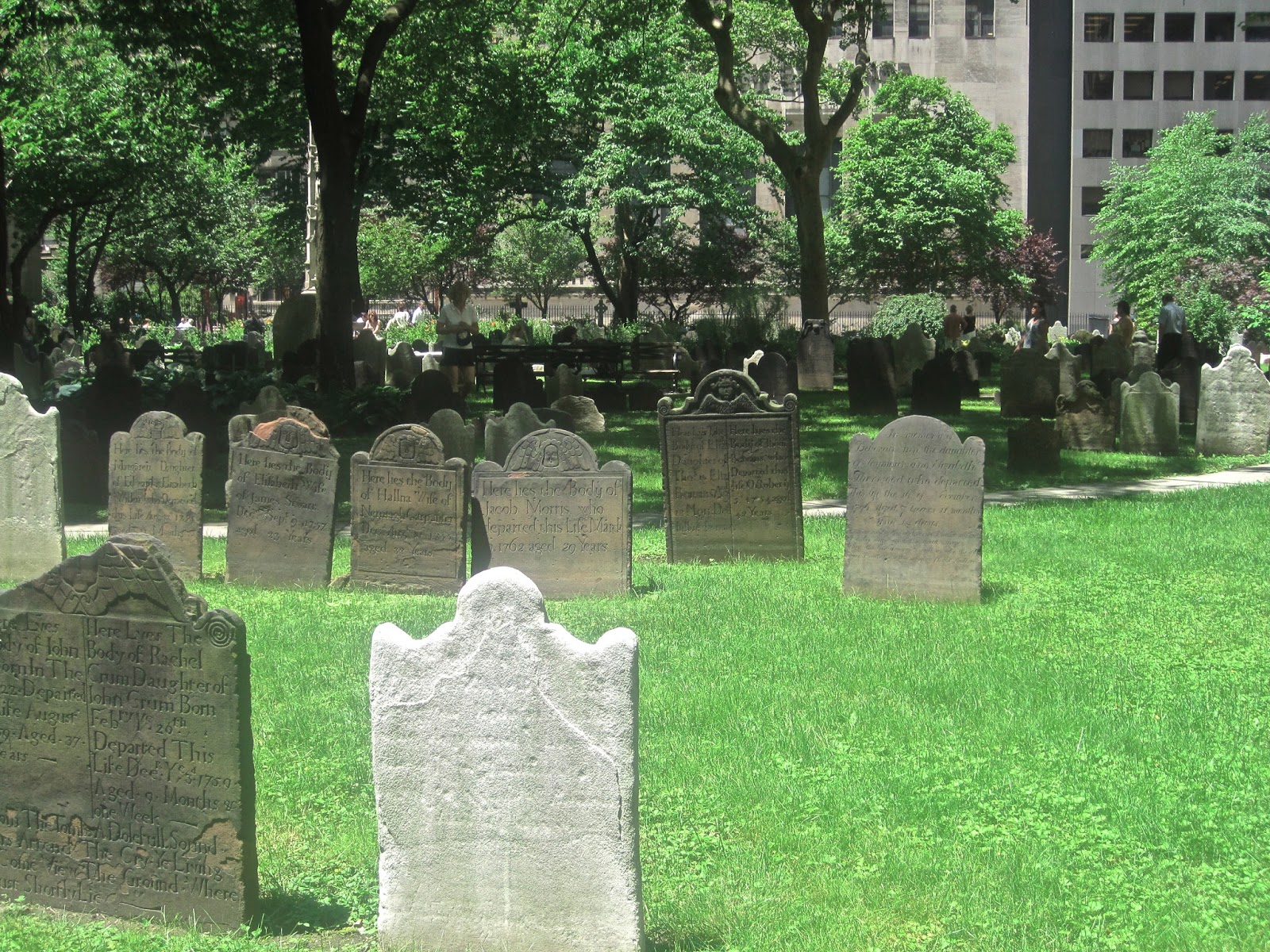
    Historians James Deetz and Edwin Dethlefsen, in their groundbreaking study in the 1960s, identified the tripartite iconographic system of New England gravestones: death's head, cherub, urn & willow. Death's head is the oldest tradition and, frankly, the coolest. In many ways, New Englanders of the seventeenth century were still living in the Middle Ages, and the death's head definitely has a medieval feel to it. A couple of weeks ago, I went to Trinity Church Cemetery on Wall Street, where you can find examples of seventeenth- and eighteenth-century gravestones with death's heads right in the shadow of skyscrapers.

    Like this one. Check out its curly eyebrows. So. Awesome.


    Saturday, July 27, 2013

    Old Burying Ground, Fairfield, Connecticut

    During my trip to Fairfield, I couldn't resist stopping by the Old Burying Ground on Beach Street, and I'm really glad I did. I saw some of the most beautiful eighteenth-century stones - if not the most beautiful - I've ever seen. Sophisticated craftsmanship and excellent preservation has a lot to do with their beauty, but the material of the stones makes a huge difference as well. I don't know what the material is, but it has a gorgeous, shimmering stripe to it, which you can see running diagonally in the stone of Samuel Osborn, above.

    The stone below was probably made in the same workshop, if not by the same artist. The death head has the same little umbrella above it, and the stripes are there, too. They're more obvious here than in the stone above, and they run horizontally.


    I'm guessing this stone below could have come out of the same workshop, although it isn't as similar to the two stones above as they are to each other. The inscription is really extensive - it's practically a C.V. If there's a stripe in this one, it's much more subtle.

    Sunday, July 21, 2013

    Cause of Death


    So far, I have documented the causes of death for 24 people buried in the cemetery. Since that isn't very much, and is spaced out over more than a century, I decided to take a look at the mortality schedules for the town to get an idea of what most people were dying of. The mortality schedule above is from 1850. None of the people listed were buried in the cemetery (that I know of), but people buried in the cemetery probably died for the same reasons.

    According to this document, 21 people died in the town in the year ending June 1, 1850. The causes of death were:

    Dysentery (11)
    Consumption (3)
    Inflammatory rheumatism (1)
    Old age (1)
    Inflammation (1)
    Paralysis (1)
    Congestion of the lungs (1)
    Cholera (1)

    More than half of these people died of dysentery. All of the people who died of dysentery died in August and September, with the exception of one who died in October. They ranged in age from one month to seventy years old.

    The one person who died of old age was a man who was 99 years old.

    Saturday, July 20, 2013

    The Old Town

    George W. Gorham's Store on West Main St. and Maple Ave.
    I have recently been in touch with Frank, the grandson of town historian Oliver Knapp (and great-grandson of the Oliver Knapp pictured in this photo), who had been kind enough to share some of his photos of the old town, such as the store of George W. Gorham, above. Below is a photo of a man Frank thinks was probably a butcher, standing in the doorway of a building on West Main Street.

    West Main Street, butcher?
    At the time the picture was taken, the building below housed the local press, post office, and a pharmacy. In 1882 pharmacy was purchased by Stephen H. Sarles, who had started working there as a teenager.

    1 January 1876

    Thursday, July 18, 2013

    James J. and Carrie J. Gorham

    When Charles and Caroline Gorham buried their two children within just a few weeks of each other in the middle of the summer of 1860, there would have been many parents in the community who knew their pain. The 1850s and 1860s were the worst decades for children in the cemetery's history. A full third of the burials that took place in those years were those of children 10 years old or younger. With the 1870s, child mortality would start to decline. The cemetery would decline, too - not of a consequence of the decreased mortality rate, but rather of the foundation of a rival cemetery several blocks away.

    But in the 1860s, the cemetery was busier than it had ever been or would be again. Dozens of caskets would have made their way up the gravel pathway to the new church, built in 1852. Others would have entered the other cemetery, behind the church, through its side entrance, via an iron gate that is now propped up against a tree. This back half of the cemetery site belonged to the Methodists, and it is where the Gorhams were buried.

    Charles W. Gorham, the children's father, was a shoemaker who was born in Connecticut around 1827. In 1850, he and his wife Caroline lived in Lewisboro with their one-month-old child, Clarence.

    1850 US Federal Census
    Unfortunately, I can't find the Gorhams in the 1860 or 1870 censuses, so a full thirty years passes before I see them again. During that time, they lost two children, and possibly more. They also had at least one grandchild. Edward Field, their grandson, was living with them in Lewisboro. Unfortunately, due to the gap in the censuses, I don't have the name of a single daughter of the Gorhams other than Carrie, the one-year-old who died in 1860.
     
    1880 US Federal Census
    Charles W. Gorham died in 1882 and was buried in the cemetery. In 1895, his 68-year-old widow sought shelter in the Westchester County Almshouse. The document below states that Caroline Gorham had one sister, one brother, and one child surviving. The reason for her stay was that she was "sick," and her chances of recovery were deemed "not probable."

    1895
    Charles and Caroline's sole surviving son, Charles F. Gorham, was living in Ansonia, Connecticut, with his family: his wife Sarah and their four daughters and one son.

    1900 US Federal Census
    I would love to fill in more details about the Gorhams - for instance: When did Clarence Gorham die and where is he buried? What is Charles Gorham's connection to the other Gorhams in the cemetery? When did Caroline Gorham die, and did she ever leave the Almshouse? And did the following children all die of the same illness?

    Carrie J. Gorham, died 1 August 1860
    George Starr Gorham, died 4 May 1860
    James J. Gorham, died 23 July 1860
    Lillian Harriet Gorham, died 17 October 1860

    It just seems like a lot of Gorham children (4) dying within a short period of time (five months).
    1. Charles W. Gorham (1827-1882) m. Caroline M. (1828-)
      1. Clarence Gorham (1850-)
      2. James J. Gorham (1856-1860)
      3. Carrie J. Gorham (1859-1860)
      4. Charles F. Gorham (1861-) m. Sarah Jane (1859-) in 1885
        1. Mable B. Gorham (1887-)
        2. Eloise Gorham (1890-)
        3. Hazel Gorham (1871-)
        4. Bessie M. Gorham (1894-) m. Charles W. Clark (1889-)
        5. Edwin W. Gorham (1896-1961)

    William F. and Elise B. Cowers Lockwood


    WANTED: Any information regarding this couple, William F. Lockwood and Elise B. Cowers. They are the only Lockwoods buried in the cemetery. She died in 1883 at the age of 44 and he died in 1889 at the age of 53. The closest match I've found is a William F. Lockwood and Elizabeth Bower who were married in the town in 1879, according to a local newspaper.