Friday, October 17, 2014

Field Day 10


While a day spent at the site is always a good day, this day was especially good. We found many notable artifacts, any one of which could have been star artifacts in its own right, but the clay pipe you see above trumped them all. We've found plenty of pipe stems and bowls, and early in the day today even found three pieces of a pipe that could be fit together, but we haven't found anything as intact as this. Note that it's not completely intact - it's missing the very end (known as the lip or bite). But given that we are digging in a trash heap, we are unlikely to find any perfectly intact specimens. Part of the value of this pipe lies in the signs of use.

We started out the day digging in Feature 4. It's funny how the abundance of the dump units can make a "regular" unit like Feature 4 seem unproductive! But we did in fact make some significant finds in Feature 4, most notably this stone bearing the marks of plug and feathering. You may recall that we found similarly cut rocks in Feature 1 last year. Notably, this stone is a lot bigger than the other ones we've been unearthing in the "foundation."


The artifacts found in Feature 4 (or more specifically, Feature 4C) today included nails, glass, slate, and an oddly shaped chunk of mortar. Marilyn and Gretchen did most of the bagging and sorting of artifacts ...


... while Harry did most of the digging. Sifting the soil from Feature 4 was a bit of a challenge at first because the soil was fairly moist. Though we always cover our units with tarps at the end of the field day to keep them dry, it's impossible to keep out moisture completely.


Later in the day we continued excavating Feature 10 in the dump. Here you can see the system, which Bruce helped to devise: a shaker screen propped up against a table where the artifacts are sorted. It works surprisingly well, despite the uneven ground and the inevitable shakiness of the shaker screen. This is perhaps as close as we've been to any gravestones, but to the best of our knowledge (based on historical records, maps, and our own surveys) we are not in danger of hitting any graves. We do, however, hit a lot of tree roots.


Besides the pipe, finds made in the dump site today included this beautiful teapot spout, which is very similar in materials to the Brown Betty teapot we found last year, but has some beautifully modeled designs in it. I love the way the glaze catches in the grooves.


Also found: the base of a gas lamp (left), the base of a bottle, a piece of transfer-printed ceramic, and an upholstery tack. We now have about ten of these tacks, all identical.


Here's a close-up of the tack along with a buckle we found. The buckle is a match for the object I couldn't identify in the last post. Any guesses as to what it might have been a part of?


Here's the pipe that came in three parts, all excavated individually from the same unit. As you can see it's pretty similar to the other, relatively intact pipe.


And here's another picture of the relatively intact pipe. I've done a little research on clay pipes (while I should be studying for midterms, naturally), and judging by this typology, it seems that our pipes date from the later period, i.e. the mid-19th century. I'll research it more when I have a little more time - most of my books are back at school anyway! What I do know is that these tobacco pipes were made of a white clay called kaolin, and I believe most of them were manufactured in England. The clay was shaped in a mold, which made it easy for manufacturers to add stamped marks. We've seen a few of these marks on other pipe stems we've found, but the two pipes we found today don't have any.

Lastly here's a picture of today's team (minus Marilyn and Laurie, who took the picture) at the dig site. 

Thursday, October 16, 2014

Field Day 9

Laurie led the dig again on Monday the 12th, which was spent digging Feature 4 - what we have been referring to as the church foundation (though it should be pointed out that that is by no means a foregone conclusion!). Having completed the excavation of Feature 4B, Laurie and Tricia strung out an additional rectangle, extending the unit four feet to the west to follow the trail of stones that we have been unearthing.


This photo shows the progress of the "foundation wall." What seemed in the original unit to be a relatively cohesive grouping of rocks has become fairly irregular and jumbled, though mixed with the same basic assemblage of architectural artifacts. Feature 4A, as you may recall, yielded one hand pestle and the gunflint, while Feature 4B produced a large number of sherds seeming to belong to a single earthenware vessel; a few pieces of worked wood (perhaps from a floor); and a large amount of slate tiles. All of the evidence seems to be pointing to the existence of a structure on this site. Was it St. George's Church? Does the irregular pattern of stones indicate some sort of structural collapse, or demolition in the process of deconstructing the building? 

Meanwhile, work also continued at the dump site, where evidence is always forthcoming. The team found some pipe bowls to match the pipe stems they found last week (I don't know if they are a literal match, but they appear to be made of the same white clay, or kaolin):


Then there is this object, which I can't identify ...


The following objects were all surface finds. Laurie researched the crock base with the name W. P. Hartley on it and dated it to about 1900.


This piece of porcelain, also a surface find, may date to the late 19th century.


The next time the team meets I will actually be able to participate. Though I've loved reading about and seeing the team's progress from afar, there's nothing like actually taking part in an excavation, getting down in the dirt, and unearthing artifacts that haven't been touched by human hands in 100 or 200 years. I am hoping that by the end of the season we'll have a better idea of what our pile of jumbled stones (aka the foundation wall) represents and how it came to be in its present state. There are definitely some mysteries here that are waiting to be unraveled.

Hans's Finds


While we have been working on the dig, Hans, the cemetery's de facto groundskeeper, has been keeping up the maintenance of the site, as well as repairing gravestones (on his own as well as with certain members of the dig team). Hans's work has led to some unexpected (in the sense that he wasn't looking for them; they're not particularly surprising given the site) archaeological finds. The artifacts in these photos were found during the restoration of the Yerks gravestones (which I will feature in a future post - it's really amazing to see them back in place). Above, you can see a sherd of salt-glazed stoneware (upper left), the tines of what looks like a hoe or a rake, and some transfer-printed porcelain. I am not sure what the blue and gray striped ceramic sherd is, but it looks similar in style (if not color) to this sherd found under the gravestone of Derinda Yerks.


Also discovered at the base of Derinda's gravestone: this coffin handle, possibly dating to the year of her death in 1856 (assuming it belonged to her coffin). We have no intention of excavating any mortuary artifacts, and thus the coffin handle will be reburied where it was found. However, it's still an interesting artifact, as well as a poignant reminder of the role that the site played for 170 years as an active cemetery.


Wednesday, October 15, 2014

Field Days 7 & 8

While I've been at school, the dig team led by Laurie has been hard at work at the site. She gave me the following photos and information to report from the field days on Monday the 6th and Sunday the 12th. The 6th was Bruce's birthday (and also my dad's - weird), so he had the honor of choosing the location for the next test unit. The team dug a small STP in this location to see what would emerge, and immediately found this padlock:


Thinking that this could very well be a productive location, the team drew out a larger unit here - between two trees and up against the southern wall of the cemetery.


As the team dug and screened for artifacts, Gretchen bagged their finds. Having bagged a lot of artifacts myself - most of them in this portion of the cemetery - I can say that it can be a challenge to keep up with the volume of artifacts being produced from the ground. In addition to documenting the provenance of the artifacts on every bag, we make a preliminary attempt to sort the artifacts as they are bagged - i.e., creating a bag for ceramics, one for glass, one for metal, etc.


Below is some of the glass the team found in this location. The glass bottles pictured at the top of this post, with the exception of the perfume bottle, were found here as well. The C. N. West Disinfectant bottle (second from the right) is actually identical to one that I found in my backyard a few years ago and dates from the early to mid-20th century. Laurie found the heart-shaped perfume bottle while poking around in the wall behind the excavation unit.


After the Saturday dig date was canceled due to rain, Laurie and Bruce went back to the site on Sunday to dig another spot in the dump, a short distance from our original STP last year. Here is a selection of their finds ...

A mason jar lid (made with printed "milk glass"), a pipe stem, and some nails (one of which looks hand-wrought though it's hard to tell from the picture and with all of the corrosion):


A medicine bottle, two more pipe stems, and the base of a glass bottle ... also what looks to be either a hook or a trammel (the metal object).


This "button" that turned out to be the label clip for a bottle of rum:


An actual button, and this strange arrow-shaped glass object that Laurie suggested could have been part of a chandelier. Any ideas?


Also, more shoe parts:


Again, the team observed the same pattern of artifact distribution, with most of the artifacts concentrated between 6 and 12 inches below the surface. For the most part, older artifacts seem to occupy the same layers as newer ones, and the majority of artifacts seem to be domestic.

Saturday, October 4, 2014

Field Day 6


Today marked a first in the history of the dig - the first field day conducted completely in the rain! We've had a few wet days before, but anything more than a light drizzle forced us to stop. Yesterday, knowing that the predicted rain was likely to interfere with our planned field day, Bruce drove to the Chapter's headquarters and retrieved this brand new pop-up tent, which John recently purchased. Thanks to Bruce's forethought we were able to work for a few hours on the foundation wall, during which we made some curious discoveries.

To begin with, this is what we have been encountering in this area of the site: lots of rocks, mixed together with mortar and architectural debris - mainly nails and slate tiles. While there are places where it appears the rocks were stacked on top of one another (mainly in Feature 4A), a lot of the rocks seem to be thrown together indiscriminately, with slate tiles crushed and wedged between them. Bruce suggested that the slate tiles were used as building materials in between the stones of the foundation wall, which Carol says is a possibility. Another possibility is that the roof caved in. The rocks could have become mixed with the slates during either the destruction or deconstruction of one of the churches.


We have several different events to account for in our reconstruction: the construction of St. George's Church (1761), the deconstruction of St. George's Church (1819 - the building was taken apart and the frame moved to a different site), the construction of St. Mark's Church (1852), the moving of St. Mark's Church (1916), as well as the many burials that took place between the 1770s and the 1940s which may have disturbed the distribution of soil and artifacts.


The picture above shows the slate and rocks emerging from the dirt. The slate seemed to be concentrated in one area - specifically the center of Feature 4B, where the rock wall (though it looks less like a wall on this side of the Feature and more like a random pile of rocks) continues. On either side of the rocks - that is, the northern and southern ends of the unit - there is dry, compacted dirt with a few rocks and some artifacts. I found quite a few nails - both handwrought and cut - in the northwest corner of the feature.


You can see that my feet are resting on the rock "wall" and that the slates are poking through the surface of the dirt right in front of me. Of the dozens of slates we uncovered today, we kept only those that exhibited a specific feature: drilled holes. These holes, which appear to be roughly square, would have been drilled prior to the attachment of the slates to the roof. The slates would have then been anchored to the roof with nails.


In this picture Don is working on screening artifacts underneath the tent. The outline of the rock foundation wall found in Feature 4A is visible in front of him (to the right in the picture). In addition to the slate tiles and nails already mentioned, we found pieces of mortar, some "fancy" glass, and pieces of a mason jar (glass rim and milk glass lid), as well as some very fine pieces of glass that Carol believes came from a lamp, and a few very small pieces of worked wood that may have come from a floor. How they made it into this pile of rubble is a mystery.

One piece of mortar had an indentation in it, indicating where a nail had been set:


Shortly after we began working it became clear that we would benefit from the use of a second screen - but space beneath the tent was limited. Bruce and Carol helped to rig up an addition to the tent using one of the tarps.


Afterwards, we screened artifacts in the makeshift tent addition. That's not a dead tree on the right; it's a branch that Laurie found in the back of the cemetery and we used to prop up the tarp. We're like archaeological MacGyvers. (Well, not so much me, but the others are.)


The "foundation wall" seems to open up more questions with every layer of earth we uncover. We realize just how little we really know about the placement of the churches in the cemetery. What we do know (basically):

-St. George's Church stood from 1761 to 1819 and had a footprint of 30' x 40'.
-St. Mark's Church stood from 1852 to 1916 and had a footprint of 30' x 50'. From photographs, it seems to have been centered in the middle of the property, just east of the row of spruce trees.
-St. George's Church described by the Rev. Thomas Dibble: "A very decent church for public worship, forty foot by thirty, with galleries, covered and closed it with cedar, and only laid the ground floor."
-St. Mark's Church described by the Rev. Robert Bolton: "It is a very neat church-like structure, and is pleasantly situated on the west side of Kirby's pond ... The building was much admired, as a beautiful model for a country church. It is fifty by thirty feet, with a tower projecting eight feet in front, and is constructed of the best materials in a substantial manner."

What we don't know:

-Whether the footprints of the buildings overlapped.
-Whether one or both of the buildings had a basement.
-Which direction St. George's Church was oriented, or any other details of its construction or appearance beyond those described by Dibble.

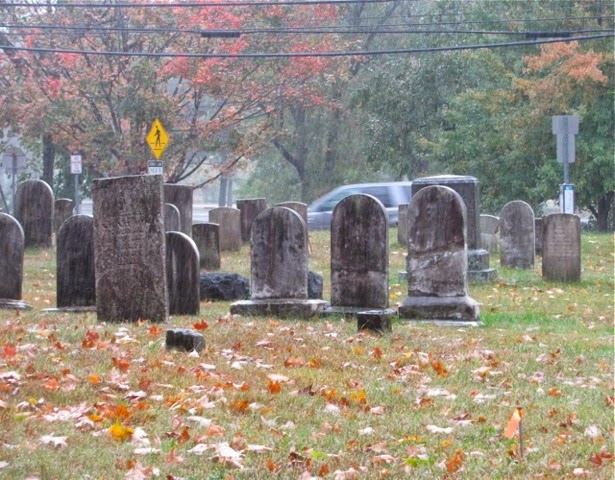
To end for today, here are some lovely pictures of the cemetery in the rain, taken by Laurie. A few of these stones have been newly reset, including the child's sandstone grave marker on the far left of the first picture.


Field Day 5


I was in class during Field Day 4, but received an overview from Laurie, who led that day's excavation in Feature 4B. She, Tricia, and Andy continued to excavate Level 1, in which they found more nails, slate, stencil-painted glass, and a one-inch fragment of a pipe stem. We continued Feature 4B today, but I'll discuss our findings in my next post. Field Day 5 took place in Feature 9, back in the dump site, where we have continued to make continuous and very exciting finds.

Before I get to that, a note on the cast-iron cap gun that we found last week. I should have mentioned it, because Bruce mentioned it at the time it was found, but the gun has a seam running along the underside of the barrel, which Bruce said would not be present in a real derringer. He agrees with JJ that real derringers would traditionally be carried by women or as a backup weapon. I am still unsure about the social and cultural implications of a child in the 1880s playing with a toy modeled after a derringer. Why would a child have wanted to play with a toy derringer instead of, as JJ mentioned, a Western-style revolver?

We didn't find any more children's toys in Feature 9, but we did find a fishing hook. Remember Kirby Pond? Well, if you don't, it was the large body of water (about 100 acres according to one account) that covered what is now a park across the road from the cemetery. This seems the most likely explanation for the presence of a fishing hook in the dump site.


Throughout the morning Bruce did most of the digging, while village historian Harry McCartney and I sorted through artifacts. This was the result: lots and lots of ceramic sherds, clam and oyster shells, bottle glass, bricks, nails, and various unidentified metal objects. Not pictured (or kept): slag, coal, charcoal, and walnuts.


As always, there were a few stand-out artifacts. One of them was the bottom of a glass bottle with a pontil mark - the second example of blown glass we have identified at the site. The first, as you may recall, was found in Feature 8 on Field Day 3. In this example, which appears to be part of a medicine bottle, the glass is much thicker than the very thin and delicate glass of the first example. 
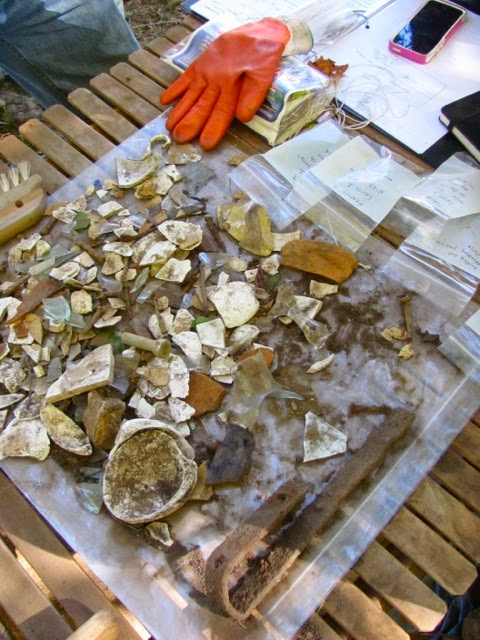
Also notable: these ceramic pieces which are a match for some found in Feature 5 last year. At first look I thought they were transfer-printed, but now I'm not so sure. They may be hand-painted. The decoration with a hatched background looks transfer-printed, but the little flowers on the sherd in the upper left corner look hand-painted. I'll have to look at them more closely. For now, what do you think?

I am more certain that these are transfer-printed, and there's not much remarkable about them except that I found them very pretty. The variety of decorated ceramics we have found in the dump site has been remarkable.

While Bruce, Harry, and I dug, sorted, and bagged artifacts, Laurie and several others - including Hans, Tricia, and Dick Schmitt - worked on the gravestones in the front of the cemetery, resetting several children's graves to their original places as indicated in the WPA map.


All in all, we made good progress, finishing the excavation of the 3' x 5' Feature 9 and then backfilling it. When we return to the dump, we plan to move north and east of Feature 9, closer to the location of Feature 5. Oh, and I nearly forgot - we believe we have found two additional pieces of the Brown Betty teapot in Feature 9. Further analysis awaits.