Showing posts with label Chestnut Ridge. Show all posts

Thursday, June 16, 2016

Zar Cemetery, Chestnut Ridge


Those of you who are long-term readers of this blog may remember my spring 2014 obsession with Chestnut Ridge, the lost hamlet. Long story short, this small community of shoemakers was settled sometime around the Revolutionary War, began to decline in the late 19th century with the encroachment of industrialization, and was finally bought out by Arthur W. Butler, a banker who converted the area into a sprawling estate. Virtually all of the farmsteads were destroyed, along with the Chestnut Ridge Methodist Church, and even graves were moved from the former hamlet into Oakwood Cemetery. However, one cemetery remains in its original location and is now part of a nature sanctuary.


The dated stones date from 1824 to 1915, but many of the roughly shaped fieldstones in the cemetery are likely older. Most of these stones are not inscribed at all. The stone above, inscribed with the initials E. A. M., is an exception. The "M" likely stands for Moore, a common name in Chestnut Ridge.

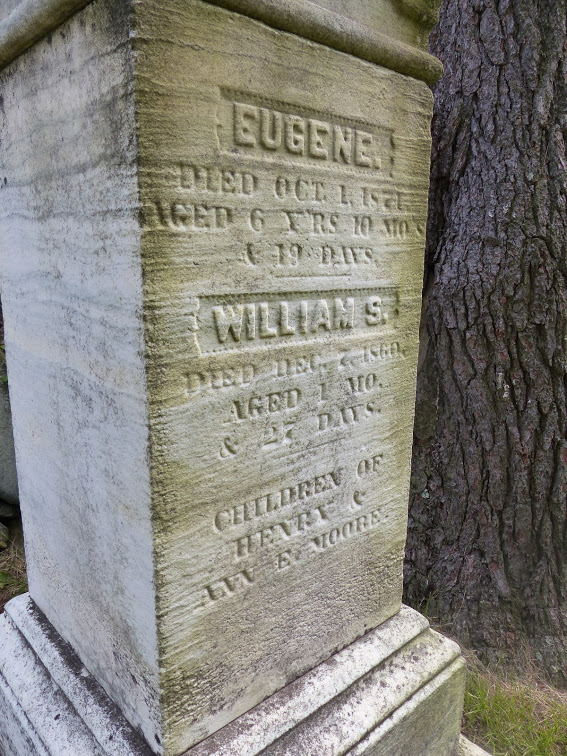
The newer stones are marble, such as this obelisk, located in the corner of the cemetery.


While the story of Chestnut Ridge is tinged with sadness - an entire community churned under the wheels of industrialization and Gilded Age splendor - it has a somewhat happy conclusion. Thanks to Butler's widow, Anna Foster Robinson Butler, the area that was Chestnut Ridge is now accessible to anyone who wants to enjoy it. The trees have reclaimed the old farmsteads and pretty much obliterated any visible remains of the old community, aside from the stone walls, which still jag through the forest, sometimes at impossible angles. 


It's a good place to go if you're interested in nature photography, particularly of wildlife. I was a little on edge as a bear was spotted in town a few weeks ago - not in the sanctuary, but on a residential street! But we managed to avoid the bears this time. Instead, we saw a red-winged blackbird and a red squirrel (photographed by my dad). Note the red theme - what could it mean?


Tuesday, March 25, 2014

More on the Chestnut Ridge Methodist Church


I found an article written by Richard N. Lander on the Chestnut Methodist Church in The Westchester Historian Vol. 51, No. 1 (Winter 1975). This photograph of the church and its stables, taken about 1900, appeared on the cover of that issue. 

Mr. Lander provides many new (to me anyway) details about the church, including:
  • The Chestnut Ridge Methodist Society was never officially organized or incorporated
  • Richard Mosher, a schoolteacher and farmer, was the donor of the land
  • Local tradition held that the congregation built the church itself, with no professional assistance
  • "The building was a plain clapboard structure with three large windows on either side, these windows were of clear glass with accompanying shutters. Across the front of the church was a porch supported by four pillars and a small enclosed entryway located between the center pillars. Inside was one large assembly room which would accommodate forty to fifty persons. The pulpit was at the west end of the room on a raised platform one step above the floor, enclosed by a communion rail with kneeling cushions in front of the rail. The room was heated by a coal stove. No tower or steeple adorned the building."
  • The church was under the charge of the Bedford Methodist Church until 1888
  • From 1889 to 1895, it was under the charge of the Mount Kisco Methodist Church
  • No one remembered when regular services stopped
  • Arthur W. Butler, who bought the land surrounding the church (along with much of Chestnut Ridge), used the church as a storehouse for farm tools before he demolished it
  • The Mount Kisco Methodist Church owns the photograph featured on the cover
  • On December 1, 1963, the author took Mrs. Olive Cunningham Heuss, who was then in her 80s and remembered attending the Chestnut Ridge Church as a child, to look for remains of the building. They found only "a scattering of foundation stones."

Monday, March 3, 2014

Jesse Zarr: A Chestnut Ridge Connection in St. Mark's Cemetery?

In my most recent posts, I've shared excerpts from Glenette Forgea's scrapbook about the lost hamlet of Chestnut Ridge. The tiny community consisted of a handful of houses along Chestnut Ridge Road, formerly known as Shoemaker's Road due to the large number of shoemakers among its residents. As Mrs. Forgea writes, Chestnut Ridge had its own Methodist church, a schoolhouse, and two cemeteries: the Byram Lake Cemetery and the Zar (or Zarr) Cemetery. The earliest inscribed gravestone in the Zar Cemetery is that of Parker Zar, a German immigrant who was born in 1765 and was one of the first white settlers of the area. As I was reading about the Zars of Chestnut Ridge, my mind flashed to Jesse Zarr, the one person in St. George's/St. Mark's Cemetery of that surname. Was there any connection between them?

Jesse Zarr's gravestone is a military-issue marble marker, one of several in the cemetery. There are no dates, only his name and the name of his regiment: the 23rd New York Volunteer Infantry. This was a Civil War regiment that was organized at Elmira, New York, in May 1861, and mustered in for service two months later. According to the regiment's roster, Jesse Zarr was 23 years old when he enlisted on May 6, 1861 for a term of two years. He was mustered out May 22, 1863, at Elmira.

What was a Westchester County boy like Jesse Zarr doing in Elmira, more than 200 miles away from the cemetery in which he would be buried? I don't know, but this is definitely the same Jesse Zarr. In 1906, he applied for a pension from the government, and in 1907 his widow Sarah Zarr filed for a widow's pension. Twenty years earlier, Jesse and Sarah had lived together in Pound Ridge, Westchester County, with their three-year-old daughter Elizabeth. Though they were not in Chestnut Ridge, Jesse was a shoemaker.

1880 US Federal Census
In 1900, the couple was still living in Pound Ridge. The number ones in Sarah's row indicate that she was the mother of one child, and that that one child was living.

1900 US Federal Census

Trying to determine why Jesse Zarr might have been in Elmira at the time of the Civil War, I went back to the census of 1860. In that year, at age 22, he was living in Elmira with a young couple, William and Caroline Shesler. There is, in fact, a tenuous connection to that name through the cemetery, in the form of Ann Cronk, a young woman buried in the Methodist portion of the cemetery who was married to George Schesler. This may, however, be a coincidence.

Jesse Zarr must have died before 1907, when his wife filed for a widow's pension. In 1910, 57-year-old Sarah Zarr was living on her own in Ossining. In 1920, she was living in Manhattan with her daughter Elizabeth "Bessie" Zarr Jacoby; Bessie's husband Henry, a German immigrant who worked as a plumber; and Elizabeth's son Edward Schnell, who was Henry's stepson.

1920 US Federal Census

As I have not yet been able to identify Jesse Zarr's parents, or anything about him prior to the 1860s, I can't say for sure whether he had any origins in Chestnut Ridge, but it seems plausible. The question of why he was buried in the St. George's/St. Mark's Cemetery remains. Perhaps he and his wife were Episcopalians (the only church in Chestnut Ridge was Methodist)? Perhaps he was moved from the Byram Lake Cemetery when it was dismantled in the early 20th century, or from the Zar Cemetery after Chestnut Ridge was abandoned?

Sunday, March 2, 2014

History of the Chestnut Ridge Church

The following was copied from J. Thomas Scharf's History of Westchester County, Volume II (1886), by Glenette Forgea in her 1940 scrapbook. Glenette's mother Lavenia Brundage played the organ at the Chestnut Ridge Methodist Church. The asterisks in the text were added by Glenette and mark her ancestors.

In 1806, chiefly through James Fountain, an ardent and able Methodist exhorter, a church of that denomination was built at the “Four Corners” two miles west of Bedford on the road to New Castle. It was known as the Bedford Methodist Church and for several years doubtless belonged to the New Rochelle circuit. In 1826 the Mount Pleasant circuit was formed and included this church and in 1833 the Bedford Circuit was set off. The appointments in the Bedford Circuit for that year and the amounts assessed to them for the finance of the circuit were as follows:

Round Hill $68.28
North Castle 39.70
Drake Waterbury’s 13.87
John Waterbury’s 14.37
New Castle 77.82
Middle Patent 82.17
Bedford 34.82
S. Moseman’s 21.50
Cherry St. 44. 68
Chestnut Ridge 48.91
To be raised by quarterly collections $58.34

It would appear from this table that the class or organization at Chestnut Ridge, two or three miles to the southwest, was stronger in membership than the one at the “Four Corners.”

In 1837 the church edifice was removed to Bedford Village and erected at the west of the Old Burying Ground, at the foot of the rocky hill. The Chestnut Ridge people were disposed to complain on account of the increased distance to the church in its new situation and set plans on foot for having a church of their own. This was accomplished after a few years and in 1846 the Church in Chestnut Ridge was erected. It was dedicated July 19, 1846. Bedford and Chestnut Ridge, together with Middle Patent, became a separate pastoral charge in 1856, being set off from the Bedford Circuit which was probably divided up about that time. The preachers to the united charge since that time have been:

1856 William Stevens
1857-58 John W. Jones
1859-60 Ira Ferris
1861-62 George Daniel
1863-65 N. S. Tuthill
1866-68 J. H. Champion
1869-71 J. H. Hawkhurst
1872-74 Edmund Lewis
1875-76 William Blake
1877-79 J. M. Burger
1880-82 R. M. Roberts
1883-85 E. H. W. Barden

A record which describes the efforts of the Chestnut Ridge people in securing their own place of worship reads as follows:

“Bedford, January 17th, 1828. Whereas the numbers of the Methodist Society and others think it necessary to erect a house for public worship in the place commonly called Chestnut Ridge in the town of Bedford to be termed or called a Methodist Chapel, yet free for others, as a house for the worship of God. They, therefore, solicit the assistance of the brethren and others. Whoever may feel disposed to contribute will confer a favour which will be thankfully received and which may possibly be attended with a blessing to themselves and many others.”

The following are among those who contributed money to help build this church. “We, the subscribers, promise to pay to the trustees the several sums annexed to our respective names.”

James Jerman $5.00
Polly Jerman 5.00
Charles Daniels 10.00
*Sally Ann Zarr 5.00
Isaac Zarr 7.50
Abraham Zarr 5.00
Jacob Zarr 4.00
*Robert Zarr 10.00
James Mosher 3.00
Benjamin Williams 2.00
Isaac Daniels 1.00
Moses Shelly 1.00
Jonathan Mosher 3.00
Sarah Mosher 3.00
James Williams 2.00
James Williams (Jr?) 2.00
Rhuben Sniffin 1.00
Samuel Lyons 10.00
Nathaniel Lockwood 2.00
William Marshall 2.00
William Wells 1.00
Nathaniel Harris 1.25
Robert Flewellin .75
Mary Shelly 1.00
Eleanor Graham .25
Abigail Elias .26
Anna Feeks .25
Joseph B. Woolsey .25
John Zarr 2.50

On same record: “At a meeting held at the home of the *widow Sarah Zarr on the 8th of March 1828 it was voted and carried that *Elias Zarr, Robert Zarr, Hezekiah Sarles, *Isaac Reynolds, and Charles Daniels should be the trustees to erect the Methodist Chapel in Chestnut Ridge.”

The land for the church was given by Richard Mosher. The church was first under the jurisdiction of the Middle Patent M. E. Church, later Bedford Village, and lastly the Methodist Church in Mount Kisco. *Miss Lavenia Brundage was the organist of the church for a number of years and helpful in the Sunday School until her marriage to Clarence White in June 1895. When the church was no longer in use, the seats or benches were removed to the Methodist church in Mount Kisco and are still being used in the Sunday School rooms. The church was torn down around 1925, also the sheds.

Chestnut Ridge in Maps

The map above is from the 1867 Beers Atlas. I believe the "Joint Dist." in the green square is Chestnut Ridge, though the name is not on the map. The M. E. Church marked on the map was built in the 1840s and torn down in 1925. Mrs. Forgea's mother, Lavenia Brundage, was the organist there for several years.


Here is the same view in 1881. As you can see, it's mostly unchanged.


This is the same view in 1901. As you can see, the Prospect Hill Farm and the Combs View Farm are now longer marked. However, many of the same names are still there - plus a few new ones. By this time, Glenette's mother had married Glenette's father, Clarence Smith, and moved into the village, where Glenette was born in 1897.


Now, in the Westchester County Atlas of 1929-31, you can really appreciate the change in the landscape. The old community of Zars, Brundages, Reynolds, and Searleses is gone, replaced by massive estates, most notably that of Arthur W. Butler. The Chestnut Ridge Methodist Church is gone. Ironically, this is the first map in which the word "Chestnut" appears.

Another irony - though Arthur W. Butler may have virtually destroyed Chestnut Ridge, he was also responsible for saving it. Today most of his property is a nature preserve, meaning that the remains of Chestnut Ridge are likely intact beneath the surface. It would make a wonderful site for an archaeological excavation one day.

Saturday, March 1, 2014

Chestnut Ridge

The following was written in 1940 by Mrs. Glenette Forgea in her scrapbook of local history. Mrs. Forgea, nee Smith, was a descendant of the early settlers of Chestnut Ridge. The photo on the right shows Mrs. Forgea (right) with my great-grandmother Ruth Waldie, Mrs. Forgea's daughter Ruth, and Ruth Waldie's children Janet and Robert in 1937.

In treating with the history of New Castle Corners, the Village of Mount Kisco, or Bedford, mention should be made of a community called “Chestnut Ridge,” being passed out of existence. This community consisted of twenty or more small farms, all of them contiguous on both sides of the Chestnut Ridge Road and in the vicinity of Byram Lake. It was situated about four miles southeast of Mount Kisco. The Chestnut Ridge Road connected South Bedford Road and the Armonk Bedford Road.

The settlement of this little community antedated the Revolutionary War. The Mosher house was definitely known to have been built prior to the Revolutionary War and it is very likely there were others built at a very early date. At least three of the old homes are still standing (there was a tavern called Reynold’s Tavern of Chestnut Ridge in 1798). The settlers were all of good American stock, proud, patriotic, thrifty, and very religious.

Chestnut Ridge was situated in the town of Bedford. In Scharf’s History of Westchester County there is a record pertaining to Bedford, reading as follows: “On September 28, 1702 the town meeting directed that the new land should be laid out in 36 lots of 50 acres each or 60, if the land will hold out,” and ordered that convenient highways be made. The committee for this important work consisted of Zachariah Roberts, John Copp, Stephen Clason, Nathan Clark, John Miller Jr., Jonathan Miller, John Wascot, and Richard Wascot.

Copp began his work at Broad Brook Swamp at a place called Cohansey (where Aaron Sutton later resided) and laid out a ten rod highway westward to Kisco Brook. There was also a large tract of land about Chestnut Ridge left undivided and smaller tracts in other parts of the purchase. It was probably only a few years later that the Chestnut Ridge land was laid out in lots.

The life of the Chestnut Ridge settlement was at the peak of its existence about 1846 when it built its own Methodist Church.

As was mentioned, most of these farms were small and extensive farming was not carried on. Most every home was engaged in shoemaking. Shoemaking was an employment very much in vogue in those days as the machine age had not made its entrance into the land. Charles Wesley Brundage made a health shoe for Dr. Kaylor of New York City. Charles Brundage (son of William L. Brundage) was another very fine shoemaker. Many of the women made extra money by sewing on men’s shirts, the piecework being brought to their homes by various men in that business. A well-known man in that business was Morris Lissauer of Mount Kisco. The shoemakers and farmers helped each other out in time of haying, planting, or when a well was to be dug.

There were no stores in Chestnut Ridge. Most families had one or two horses and drove into New Castle Corners or Bedford Village on Saturday nights for their provisions. Through the week business men from Mount Kisco or Bedford would drive a wagon through the Ridge and usually the wagon carried everything imaginable – grociers, meats, dry goods, drugs, tinware, etc. Walter Osborne of Mount Kisco had such a route through the Ridge at one time.

The children of this community attended the little one room red school house located near the intersection of Chestnut Ridge Road and the Bedford-Armonk Road, called the Coman Hill School. Many of the children had several miles to walk. Slates were used in those days.

The Ridge had quite a reputation for its Camp Meetings and they were attended by the townspeople of Mount Kisco, also (Outdoor temperance meetings, lasting three hours, were held in Chestnut Ridge). Old timers tell of the many good times spent in Chestnut Ridge, the gay parties, sociables, and quilting bees. Some of the homes had organs and frequent evenings of song have been related. Because of the Ridge’s proximity to Byram Lake, most all the families had row boats and good times were spent in rowing and fishing.

The people of the Ridge received their mail by means of R. F. D. #1.

The settlement had two cemeteries – one on Byram Hill and the Zarr Cemetery. The Zarr Cemetery was used by many of the families of Chestnut Ridge – Adams, Sands, Moore, Brundage, Daniels and others – but in historical records it is referred to as the Zarr cemetery. The property about the Byram Hills Cemetery was bought up by various wealthy men and made into large estates and for that reason it was arranged to remove the bodies to Oakwood Cemetery in Mount Kisco – accounting for the very old dates of some of the markers and the old style of stones, for Oakwood is of comparatively recent origin. The Zarr Cemetery remains intact except tha tmany of the stones are fallen and embedded. It is now enclosed by a stone fence built by Mr. A. W. Butler, who bought up all the surrounding property. The oldest stone in the cemetery is that of Parker Zarr, born April 20, 1756 and died May 7, 1824. The last burial was that of Reed Adams (father of Eugene Adams) born June 22, 1821 and died November 22, 1915.

About 1908, Mr. Butler bought up most of the farms of Chestnut Ridge, which form his very large estate. Most of the families moved to the village of Mount Kisco, and the old homesteads have been torn down. Walter and Solomon Brundage, two old and beloved Chestnut Ridge residents, moved to Moger Avenue in Mount Kisco and lived there until their deaths. Mr. Charles Wesley Brundage was the oldest inhabitant to remain in Chestnut Ridge, having received a lifelong permit to live in his old home. The house now used as Mr. A. W. Butler’s superintendent’s house was one of the newer houses built in the Ridge. It was built by Solomon Brundage upon his retirement from the police force of New York City. The church was left standing for a number of years but was finally torn down, around 1925, thus erasing every vestige of the settlement called Chestnut Ridge.

---

Addenda

It has been revealed by Ronald Reynolds that the Chestnut Ridge Road was at one time called Shoemaker Road. That name presumably resulted because practically every house in the Ridge conducted shoemaking. It was an honorable trade in those days and, of course, was prior to the machine age.

When the machine age reached these parts there was a serious blow to the inhabitants of the Ridge and most likley, without that income, the cause of selling their lands, one by one, and the beginning of the inevitable decline of the existence of the settlement that was called Chestnut Ridge.